 Economy



NA President tours revolutionary sites in China’s Shaanxi
1.
|
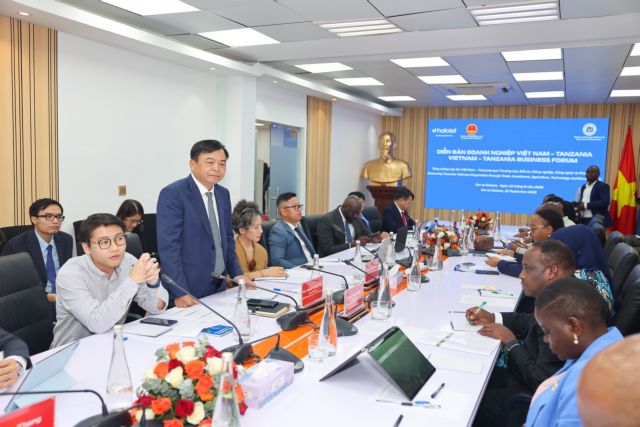
| Vietnamese delegation representative speaks at the Việt Nam-Tanzania Business Forum. — VNA/VNS Photo |
HÀ NỘI — The Việt Nam-Tanzania Business Forum was held in Dar es Salaam on September 22, providing a platform for government agencies and businesses from the two countries to exchange views and explore concrete opportunities for trade and investment cooperation.
The forum was organised by the Embassy of Việt Nam in Tanzania in coordination with Việt Nam’s Ministry of Agriculture and Environment, Tanzania’s Ministry of Foreign Affairs and East African Cooperation, and Viettel Tanzania (Halotel).
The event was among the key activities held on the sidelines of the second session of the Vietnam-Tanzania Intergovernmental Committee.
Vietnamese participants included Deputy Minister of Agriculture and Environment Nguyễn Hoàng Hiệp, Chairman of the Vietnam Subcommittee of the Vietnam-Tanzania Intergovernmental Committee, Deputy Head of the Vietnamese delegation Phạm Ngọc Mậu, Ambassador of Việt Nam to Tanzania Vũ Thanh Huyền and around 30 representatives from the subcommittee and major Vietnamese businesses, including Vingroup, Intimex, Phulimex and Halotel.
The Tanzanian side was represented by Deputy Minister of Foreign Affairs and East African Cooperation James Millya, along with representatives from ministries, agencies and businesses involved in trade, investment, agriculture, land, fisheries and energy.
In his opening remarks, James Millya said the forum reflected the two governments’ determination to promote economic diplomacy and translate strong political ties into tangible results in trade and investment.
According to Tanzanian figures, the country’s trade surplus with Việt Nam increased from US$141 million in 2022 to $314.2 million in 2025. Việt Nam is currently a key market for Tanzanian agricultural products, particularly cashew nuts. The International Trade Centre (ITC) has also identified Việt Nam as one of Tanzania’s most promising export markets.
James Millya also praised Halotel’s contributions to developing telecommunications infrastructure, expanding internet coverage, creating jobs and improving the technical skills of local workers. He expressed hope that this successful model could be replicated in other sectors.
The Tanzanian side highlighted strategic orientations under its Development Vision 2050, including major projects such as the Standard Gauge Railway (SGR), the Port of Dar es Salaam, the Julius Nyerere Hydropower Project and a network of special economic zones.
Priority investment sectors include agro-processing, particularly cashew nuts, cotton, sesame and coffee; the marine economy; textiles and garments; renewable energy; mining; and digital technology.
Both sides noted strong complementarities between Tanzania’s abundant raw materials and Việt Nam’s strengths in processing technology, supply chains and access to international markets.
Deputy Minister Hiệp shared Việt Nam’s experience in agricultural production, processing and exports, and proposed strengthening South-South cooperation in agriculture through technology and technical transfers linked with investment and market expansion.
Ambassador Huyền stressed the importance of direct business-to-business connections in turning high-level commitments into concrete projects. The Vietnamese Embassy in Tanzania pledges to support businesses by providing information and facilitating partnerships on the basis of mutual benefit, she said.
During the forum, Vietnamese businesses and Tanzanian partners, including TANICA, the TMX Commodity Exchange, the Cashew Board and the National Irrigation Commission, introduced their capabilities and discussed potential areas of cooperation.
The forum strengthened links between government agencies and businesses of the two countries while providing fresh momentum for discussions at the second session of the Vietnam-Tanzania Intergovernmental Committee, contributing to efforts to deepen bilateral economic ties. — VNA/VNS
Economy
 Economy
 Economy
 Economy
 Economy
 Economy
 Economy
 Economy
 Economy
 Economy
 Economy
 Economy
 Economy
 Economy
 Economy