 Economy



Việt Nam, Denmark issue joint statement on establishment of Comprehensive Strategic Partnership
1.
|
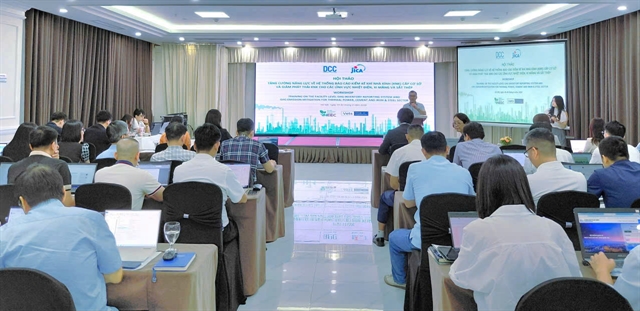
| Participants at a recent workshop on greenhouse gas emissions reporting and reduction. — Photo courtesy of the Ministry of Agriculture and Environment |
HÀ NỘI — Accurate greenhouse gas (GHG) inventories will be critical for businesses seeking to participate in Việt Nam's pilot carbon market, officials said as the country officially launched its domestic carbon trading platform on Monday.
Speaking at a workshop in Hà Nội held on June 29 and 30, representatives from the Department of Climate Change under the Ministry of Agriculture and Environment said reliable emissions reporting would underpin the allocation and trading of emission quotas under the new market mechanism.
The two-day workshop focuses on strengthening capacity for facility-level GHG reporting and emissions reduction in the thermal power, cement and steel industries.
It comes as the Government accelerates the rollout of the domestic carbon market.
Earlier this year, the Prime Minister approved the total pilot greenhouse gas emission quotas for 2025–2026, followed by the ministry's allocation of emission quotas to thermal power plants and cement and steel producers participating in the pilot scheme.
Lương Quang Huy, head of the Greenhouse Gas Emissions Management and Ozone Layer Protection Division under the Department of Climate Change, said the opening of the domestic carbon exchange marked a milestone in Việt Nam's efforts to develop a carbon market, with companies completing their first emission quota transactions on launch day.
However, he stressed that the success of the market would depend on accurate and transparent GHG inventories at the facility level.
"Reliable emissions data are essential for allocating quotas fairly and enabling carbon trading," Huy said.
During the 2025–2026 pilot phase, 110 facilities will participate, including 34 thermal power plants, 25 steel producers and 51 cement manufacturers.
Authorities are working with ministries, industry associations and businesses to standardise emissions calculation methods and reporting procedures.
Lương Đức Long, vice chairman and general secretary of the Vietnam Cement Association, said the carbon market would both increase pressure and create opportunities for the cement industry to accelerate green technology adoption and improve competitiveness through lower emissions.
According to Long, the pilot scheme had also highlighted challenges in the allocation of emissions quotas.
While some cement producers received quotas broadly in line with their recent production, others were allocated allowances well below their actual emissions, he said.
Long called for a more flexible allocation mechanism that takes account of production changes and differences in emissions intensity among companies.
Responding to industry concerns, Huy said Việt Nam was using historical emissions data to allocate quotas during the pilot phase, adding that a benchmark-based approach could create significant disparities if introduced too soon, given wide differences in technology and emissions intensity across industries.
|
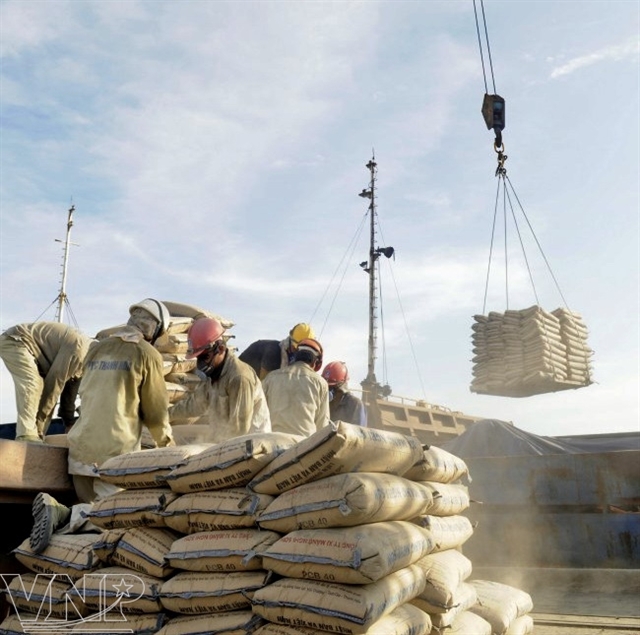
| Cement is loaded for shipment at Nghi Sơn Deep-water Port in Thanh Hóa Province. — VNA/VNS Photo by Trần Thanh Giang |
The workshop also forms part of international efforts to support Việt Nam's nationally determined contributions under the Paris Agreement. Activities include developing measurement, reporting and verification systems, improving GHG inventory practices and helping businesses identify cost-effective emissions reduction measures.
Akiko Ashii, a representative of the Japan International Cooperation Agency in Việt Nam, said carbon reduction has become an irreversible global trend and praised Việt Nam's progress in establishing emissions inventories, preparing an emissions trading system and developing a domestic carbon market.
She said accurate emissions measurement and reporting will become increasingly important as climate regulations tighten globally, adding that the current training programme will help businesses prepare for the next national GHG reporting cycle, scheduled for March 2027.
Ashii also shared Japan’s experience in developing emissions reporting systems and improving energy efficiency in carbon-intensive industries, including thermal power, cement and steel, providing useful lessons for Việt Nam.
She noted that while these sectors are among the country's largest emitters, they also offer significant potential for emissions reductions through technology upgrades and more efficient energy use.
During the workshop, participants are also receiving guidance on the updated regulatory framework, using the national GHG reporting system, calculating emissions and preparing emissions reduction plans, with specialised training tailored to the thermal power, cement and steel sectors. — VNS
Economy
 Economy
.jpg) Economy
Economy
 Economy
 Economy
 Economy
 Economy
 Economy
 Economy
 Economy
 Economy
 Economy
 Economy
 Economy
 Economy