 Economy


Việt Nam, China seek stronger substantive parliamentary cooperation
1.
|
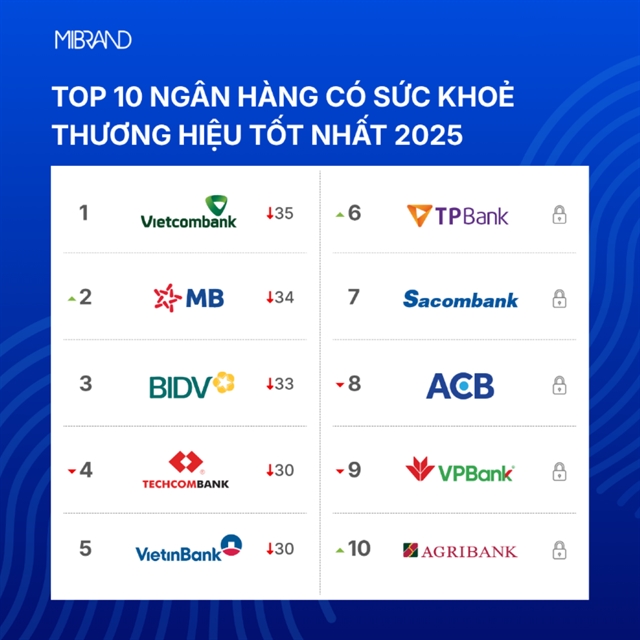
| According to the rankings, Vietcombank has maintained its No.1 position for the fourth consecutive year. — Photo courtesy of Mibrand |
HÀ NỘI — The 2025 bank brand rankings point to notable shifts in Việt Nam’s banking sector, highlighting a transition from awareness-driven positioning towards customer experience as expectations continue to rise.
According to the latest report, Vietcombank has retained its No.1 position for the fourth consecutive year, reinforcing its strong brand foundation and high level of trust in the market.
The Vietnam Banking Brand Health Report 2025, released by Mibrand Vietnam JSC, is the eighth edition of the publication. The rankings are based on the firm’s proprietary Brand Beat Score (BBS) index.
The 2025 landscape suggests the banking sector is entering a more competitive phase. While leading banks have largely retained their positions, most brands recorded a decline in overall scores. This reflects mounting pressure from increasingly demanding customers and a narrowing gap between competitors.
MB rose to second place, signalling a significant improvement in brand health. BIDV and Techcombank remained in the Top 4, while VietinBank ranked fifth. TPBank made a notable leap, climbing from ninth to sixth.
The Top 10 also included consistent appearances from Sacombank and ACB, with VPBank and Agribank rounding out the group of leading banks in terms of brand health.
From awareness to experience
This year’s findings show that brand strength is no longer determined primarily by visibility or scale. Instead, it increasingly depends on how effectively banks translate technology into tangible customer experiences and perceived value.
A key highlight of the 2025 report is the Brand Association and Image index. VIB recorded a sharp rise, moving from outside the Top 10 in 2024 to leading the industry in 2025 with a 32 per cent vote share. This suggests stronger brand positioning and more consistent messaging.
VPBank also posted significant gains, rising from 10th place with 9 per cent in 2024 to fourth with 26 per cent in 2025. Meanwhile, HDBank returned to the Top 7 after a year’s absence, reflecting effective repositioning efforts.
These movements underline a broader trend: banks are investing more systematically in brand strategy, where consistency, memorability and customer experience are becoming decisive factors.
In the Brand Awareness and Consideration category, Agribank stood out by reaching the Top 3 in awareness and Top 2 in consideration while re-entering the Top 10 overall. The result indicates that increased visibility, when paired with practical solutions, can directly influence customer preference.
TPBank also delivered one of the strongest performances in Brand Love, jumping nine places to enter the Top 5. The bank also saw significant growth in both brand love and willingness to pay a premium, signalling stronger market appeal.
Outside the Top 10, OCB remained a notable performer, ranking among the Top 15 strongest banking brands with a BBS score of 17.6. It maintained stable positions across several indicators, including familiarity, value for money, perceived quality and recommendation. Notably, OCB climbed five places in brand love, becoming one of the Top 7 most favoured banks outside the Big4 group.
Among leading banks, each continues to demonstrate distinct strengths. Vietcombank leads across multiple indicators, from top-of-mind awareness to perceived quality and brand affinity. MB’s rise is driven by its digitalisation strategy and diversified ecosystem, particularly among primary users. BIDV stood out for the most effective communications, with 76.8 per cent of customers impressed by its advertising.
Lại Tiến Mạnh, chief executive officer of Mibrand Vietnam, said the report highlighted a critical challenge for the sector: not just increasing visibility but building distinct and recognisable brand identities.
“As banks continue to promote similar messages around technology, convenience and experience, the risk of brand homogenisation is becoming more apparent,” he said.
According to Mạnh, long-term competitive advantage will belong not to those that communicate more but to those that build clear, consistent brand associations backed by tangible proof points that reinforce trust and perceived value.
The report is based on more than 2,000 independent consumer interviews conducted nationwide along with historical data collected since 2017. It evaluates brand health across multiple touchpoints, from initial awareness to long-term customer engagement. — VNS
Economy
 Economy
 Economy
 Economy
 Economy
 Economy
 Economy
 Economy
 Economy
 Economy
 Economy
 Economy
 Economy
.jpg) Economy
Economy
 Economy