 Economy

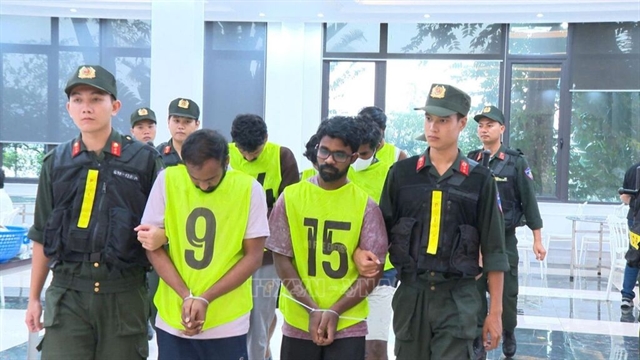
84 individuals investigated for transnational online frauds
1.
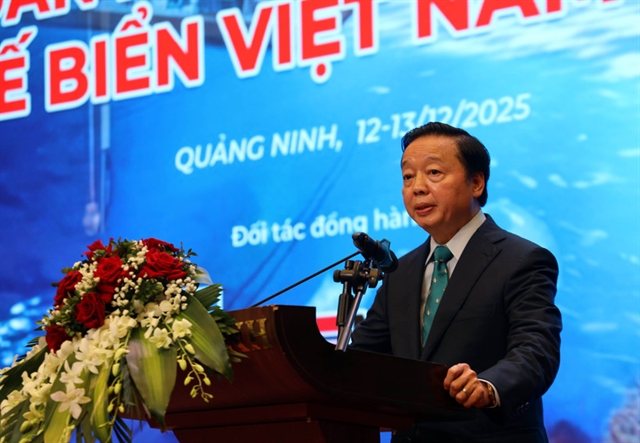 |
| Deputy Prime Minister Trần Hồng Hà at a forum on Việt Nam’s Strategy for Sustainable Marine Economic Development to 2030, with a vision to 2045 in Quảng Ninh Province on Friday. VNA/VNS Photo |
HÀ NỘI Deputy Prime Minister Trần Hồng Hà attended the forum in Quảng Ninh Province as part of efforts to implement Resolution No 26/NQ-CP, which outlines the master plan and five-year plan to carry out Resolution No 36-NQ/TW on Việt Nam’s Strategy for Sustainable Marine Economic Development to 2030, with a vision to 2045.
He stressed that marine economic development must follow a modern and sustainable path, with stronger application of science and technology and close integration with digital and green transitions. Priority should be given to developing key marine economic sectors with high added value, including industrial-scale marine aquaculture, sustainable fisheries, maritime services and logistics, and the marine circular economy.
The Deputy PM said sustainable marine economic development requires upgrading the growth model towards higher quality, based on innovation, advanced science and technology, and deeper international integration. At the same time, stronger efforts are needed to control pollution, protect the marine environment, expand marine protected areas and respond to climate change, thereby contributing to national security, sovereignty protection and maritime diplomacy.
He noted that achieving sustainable marine economic development requires renewed thinking and further improvement of mechanisms and policies, together with the active participation of businesses, scientists, local authorities and the international community. The initiatives shared at the forum, he said, open up new approaches and lay an important foundation for Việt Nam to move up the global ocean value chain.
According to Minister of Agriculture and Environment Trần Đức Thắng, the marine economy is not only a key economic sector but is increasingly becoming a strategic development space for the nation, where economic growth, security, environmental protection and international standing converge. Sustainable marine economic development therefore reflects Việt Nam’s modern governance capacity and long-term vision in the 21st century.
With the strategic orientation of the Party and State, a series of important resolutions and policies have been issued in recent years, providing a clear framework for sustainable marine economic development. This requires not only expanding the scale of growth, but more importantly renewing the development model to ensure closer integration between economic growth, resource security, ecosystem protection and long-term national interests.
A strong marine economy, Minister Thắng added, depends on the proactive engagement of businesses, scientists, localities and international partners. The initiatives discussed at the forum are expected to help shape new approaches and create momentum for Việt Nam to strengthen its position in the global ocean economy. The Ministry of Agriculture and Environment, he said, is committed to accelerating institutional reform, removing bottlenecks and creating a transparent and favourable investment environment.
At the forum, delegates held discussions and policy dialogues to review the implementation of Resolution No 36-NQ/TW dated October 22, 2018, adopted at the eighth plenary session of the 12th Party Central Committee, on the Strategy for Sustainable Marine Economic Development to 2030, with a vision to 2045. The exchanges also focused on mobilising resources for sustainable marine economic development in the new phase.
The policy dialogue session also clarified three major groups of issues: identifying a suitable marine growth model for the new context based on green transition, digital transformation, innovation and international cooperation; developing a comprehensive marine economic ecosystem covering infrastructure, energy, logistics, supporting industries, coastal urban development, human resources and ocean research and forecasting centres; and strengthening modern marine governance through transparent and effective institutions, advanced marine monitoring systems, pollution control and ecosystem restoration. VNS
Economy
 Economy
 Economy
 Economy
 Economy
 Economy
 Economy
.jpg) Economy
Economy
 Economy
 Economy
 Economy
 Economy
 Economy
 Economy
 Economy