 Economy



AITO Looks Ahead to Europe, Building a Thriving Automotive Ecosystem
1.
|
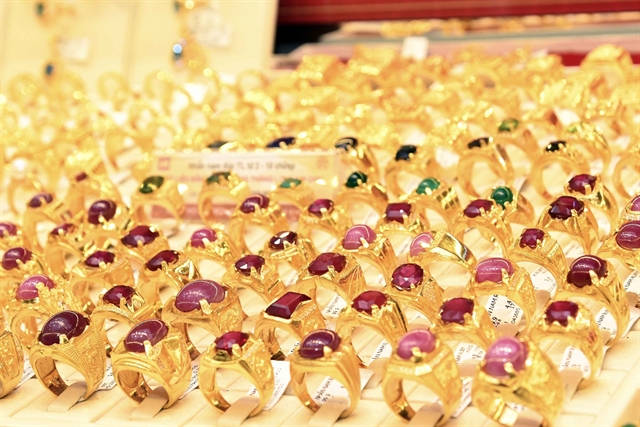
| Gold rings at a store of DOJI. The proposed loosening control on jewellery gold is expected to create room for growth. — VNA/VNS Photo Trần Việt |
HÀ NỘI — The Việt Nam Gold Traders Association has proposed that controls on gold jewellery be loosened by removing the production or sale of these items from the list of conditional business activities.
In a document sent to the National Assembly, the association said that gold jewellery should be treated as a normal commercial product, calling for a phased roadmap to ensure transparency and avoid market disruptions.
Under the proposal, the production, processing and trading of jewellery and fine art gold, as well as the import and export of raw gold materials for jewellery production, would be excluded from the conditional business lines category, which requires licences for operation.
If approved, the gold-related conditional business lines on the draft amended Law on Investment would be limited to bullion production and trade, gold derivatives and gold trading floors.
In international markets, jewellery and fine art gold production and trading are typically treated as ordinary commercial activities. No other country classifies them as conditional businesses, according to the association.
The association also noted that gold jewellery producers in Việt Nam had faced persistent difficulty in accessing raw gold for decades due to strict licensing requirements for raw gold imports, despite heavy investment in machinery, technology, factories and the workforce.
As a result, most gold jewellery businesses must suspend operations or scale back, with a majority operating at only 30 per cent of their capacity. This led to insufficient supply, rising prices and complex gold smuggling, the association said.
However, Vietnamese gold jewellery producers were still able to meet domestic demand, and were also capable of competing in export markets, helping generate foreign exchange revenues, the association said.
The association estimated demand for gold used as raw material for bullion and jewellery production at about 50 tonnes per year, equivalent to roughly US$5 billion, or about $420 million per month.
If allowed to import around 25 tonnes of gold for production and export, the gold sector could generate up to $5 billion in revenues per year.
Nguyễn Trí Hiếu, an expert in finance and banking, said that gold jewellery should be treated as a normal consumer product.
Gold bars and raw gold can impact the macroeconomy, as speculation or excessive investment could affect foreign exchange reserves, inflation and national reserves. As a result, the production and trading of raw bullion should be regulated as a conditional business line, Hiếu said.
But gold jewellery does not pose similar macroeconomic risks and should be removed from the list of conditional business lines, according to Hiếu.
In countries like the US, gold jewellery producers and traders only require normal business registration rather than special permits.
Removing gold jewellery from the list of conditional businesses would help create a more open and transparent market in line with supply and demand, Hiếu added.
According to Nguyễn Quang Huy from the Faculty of Finance and Banking at Nguyễn Trãi University, gold jewellery is more commercial and creative in nature, and less tied to monetary policy goals, than bullion.
However, Huy also said that a careful roadmap for the removal of licensing mechanisms on gold jewellery would be needed to maintain market stability and balance the interests of related parties.
Huy noted that gold jewellery products had undergo processing that altered their form and value, meaning they would no longer depend solely on raw gold prices. That was why many countries had classified them as ordinary commercial goods.
Loosening control would also create room for growth in the sector, which would create jobs and promote the development of supporting industries, he added.
Still, he said, management must ensure market stability. Mechanisms for gold content testing, product standards and transparent labelling should remain in place to protect consumers and build brands for Vietnamese gold jewellery. A clear traceability system was also needed to ensure transparency.
Huy proposed establishing a reporting mechanism for high-volume transactions with reasonable thresholds to improve market transparency and safety.
For a sensitive market like gold, a step-by-step implementation roadmap was needed, from pilot implementation to evaluation then expansion, he said. — VNS
Economy
 Economy
 Economy
 Economy
 Economy
 Economy
 Economy
 Economy
 Economy
 Economy
 Economy
 Economy
 Economy
 Economy
 Economy