 Economy


MoF's firms report strong growth in nine-month
1.

|
| A conference on legal aid for SMEs, household businesses, individual business owners and legal officers in Hải Phòng in November. — Photo haiphong.gov.vn |
HÀ NỘI — From national policy frameworks to local legal dialogues, Việt Nam is steadily assembling a legal safety net to help small- and medium-sized enterprises (SMEs) comply with regulations, avoid disputes and adapt to a fast-changing business climate.
These efforts are now accelerating as the country works toward an ambitious target of at least two million enterprises nationwide by 2030 – a goal embedded in government and Party policy.
"With nearly 97 per cent of Việt Nam's enterprises classified as small- and medium-sized, the demand for legal aid will continue to rise," said Lê Vệ Quốc, Director of the Department of Law Popularisation and Education.
Legal support for SMEs rests on a framework first laid down in the Law on Support for SMEs in 2017, which formalised two central pillars: nationwide legal information systems and structured programmes for training and legal consultation.
That foundation was strengthened in 2019 with the issuance of Decree 55, which detailed the types of support available and assigned implementation responsibilities to ministries and local governments.
Since then, the system has continued to expand. A national legal support portal for SMEs now hosts hundreds of articles, guidance documents and legal updates.
A formal network of licensed lawyers and law organisations has been created to provide consultation. Financial support mechanisms allow eligible SMEs to recover part of their legal consultancy costs, lowering barriers to professional advice.
At the same time, legal support has been woven into the routine work of many ministries.
The Ministry of Finance, for instance, integrates tax and financial law guidance into its taxpayer support programmes, regularly updating regulations on e-invoices, customs procedures and preferential tariffs while maintaining channels for direct consultation and enterprise dialogue.
Other ministries, including Industry and Trade, Home Affairs, and Agriculture and Environment, provide similar support within their own regulatory domains.
At the provincial level, People’s Committees translate national policies into local action plans. Departments of Justice typically act as coordination hubs, working with tax, planning, labour and sectoral agencies to organise training courses, legal briefings, hotlines and direct consultations. These local programmes are often tailored to the specific industries and conditions of each province and city.
Business associations sit alongside the public system as key intermediaries. SME associations gather feedback from their members and relay legal concerns to regulators, while the Vietnam Chamber of Commerce and Industry (VCCI) and sectoral associations contribute to policy consultations and organise expert discussions. Their input has helped shape successive adjustments to the legal support framework.
Technology has recently become a major driver of change. The Ministry of Justice has launched a series of digital initiatives, including the development of a national legal big data system, artificial intelligence applications for reviewing legal documents and a national digital law platform.
The National Law Portal, which became operational in mid-2025, recorded more than 1.13 million visits within its first six months.

|
| The interface of the National Legal Portal. — VNS Photo |
An AI-powered legal assistant embedded in the portal has processed hundreds of thousands of user queries, allowing enterprises and individuals to search for regulations and receive guidance more quickly and at lower cost.
Officials say these tools are not only expanding access, but also generating valuable data on the issues that create the most questions, from tax and land to labour and environmental compliance, helping agencies adjust their outreach accordingly.
Against this backdrop, the next phase of legal support is taking shape. A new inter-sectoral legal support programme for 2026–2031 is being prepared as a successor to the current national programme. Draft orientations point toward a broader beneficiary base that would extend beyond SMEs to include household businesses and cooperatives, reflecting their growing role in the economy.
Support is also expected to become more targeted, with assistance organised around specific needs, practical problems and sectoral compliance requirements rather than broad, generalised training.
The revised approach also places greater emphasis on accessibility at the grassroots level. In HCM City, for example, regular legal dialogues bring enterprises face-to-face with tax officials, customs officers and land administrators to address operational issues directly.
Questions about e-invoices, fire-safety rules or land procedures are discussed in real time, with many cases resolved on the spot and others feeding into procedural improvements.
At the national level, policymakers are also reviewing how legal support is financed and delivered. The Ministry of Justice is studying ways to expand eligibility for legal assistance, increase subsidy ceilings, simplify reimbursement procedures, and formalise the role of the National Law Portal as a unified access point for citizens and enterprises.
"There must be a general mechanism for legal aid for enterprises, along with a special mechanism for specific groups that require preferential treatment," said Nguyễn Thanh Ngọc, Deputy Minister of Justice.
These changes are intended to align with a 2025 National Assembly resolution that allows for the provision of free basic legal services to micro-enterprises, household businesses, and individual business operators under special private-sector development mechanisms.
Human resources is another focus. Plans are underway to strengthen and professionalise the teams responsible for legal support, including consultants and public officials, through more systematic training and clearer performance standards. Policymakers say this human dimension remains essential alongside any digital tools.
|
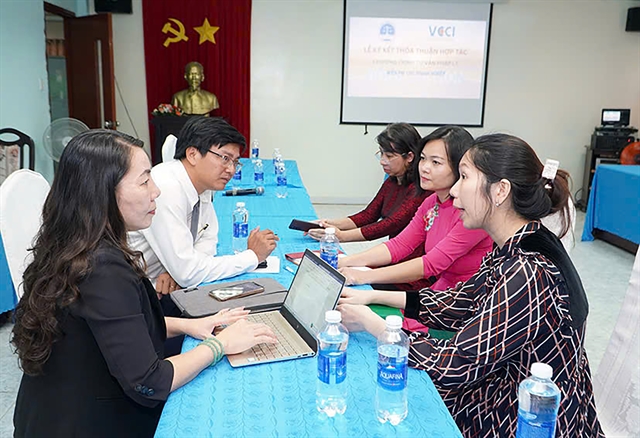
| Members of a legal advisory team formed through a cooperation programme between VCCI and the provincial bar association offer consultations to businesses in HCM City. — Photo baobariavungtau.com.vn |
While the architecture of legal support continues to deepen, actual use of the system varies widely across the SME community.
Many small firms, especially those that evolved from household businesses, still operate with limited legal literacy. Owners often concentrate on production and sales while treating regulatory compliance as a secondary concern, relying on informal advice or personal networks to resolve issues as they arise.
Even when legal information is available at no charge, micro-enterprises may lack staff with the skills to interpret and apply written regulations. For some, professional legal services are still perceived primarily as a response to disputes rather than as a preventive investment.
Administrative processes can also play a role. Under current rules, enterprises must pay consultants upfront and then submit documentation to request partial reimbursement from the State. For some firms, the time and procedural steps involved outweigh the modest financial support available.
From the supply side, although Việt Nam has a large legal profession, only a limited number of lawyers and law organisations have joined the official consultant network linked to SME support.
Surveys conducted with business associations suggest that roughly one in four SMEs has accessed the national legal support programme over the past decade.

|
| A consultation workshop in HCM City in November on the draft Prime Minister’s decision to approve the 2026–2031 inter-sectoral legal aid programme for SMEs and household businesses. — Photo pbgdpl.gov.vn |
Policymakers and business groups say this gap highlights a broader issue: while the support system has expanded, the habit of seeking out legal guidance is still uneven, leaving many firms on the margins of the services available to them.
If the next phase succeeds in combining national platforms, localised consultation and simplified support mechanisms, legal assistance could become a routine part of doing business rather than an emergency measure.
For Việt Nam’s policymakers, the goal is not simply to offer more documents or more portals, but to help enterprises 'understand correctly and act correctly' in accordance with the law, and to ensure that law compliance becomes a source of resilience rather than a constraint on growth. — VNS
Economy
 Economy
 Economy
 Economy
 Economy
 Economy
 Economy
 Economy
 Economy
 Economy
 Economy
 Economy
 Economy
 Economy
 Economy