 Politics & Law
Vietnamese Prime Minister meets with top Lao leader in Vientiane
1.
|
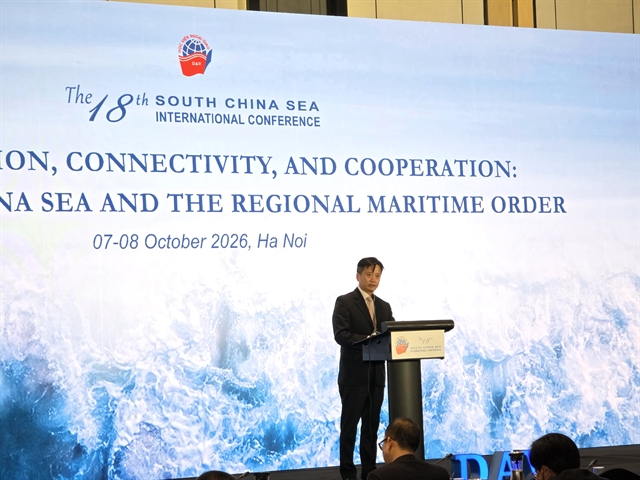
| Dr Nguyễn Hùng Sơn, President of the Diplomatic Academy of Việt Nam, gave the remarks at the closing of the 18th International Conference on the South China Sea in Hà Nội on October 8. — VNS Photo Trọng Kiên |
HÀ NỘI — Stability in the South China Sea (known in Việt Nam as the East Sea) should not be judged simply by whether agreements are signed or are going to be signed, but by whether they reduce actual risks on the ground, Dr Nguyễn Hùng Sơn said at the closing of the 18th International Conference on the South China Sea in Hà Nội on Thursday.
Organised by the Diplomatic Academy of Việt Nam under the theme “Contestation, Connectivity and Cooperation: The South China Sea and the Regional Maritime Order,” the two-day conference brought together experts and policymakers to discuss challenges facing the region’s maritime order.
Discussions focused on four major areas: managing disputes while upholding rules and preventing crises; protecting connectivity, freedom of navigation and infrastructure resilience; promoting practical cooperation to address common needs; and building an inclusive and stable maritime order based on international law and shared responsibility of regional countries.
Participants noted that although no major conflicts have occurred, the East Sea is facing long-term strategic competition. Gray-zone activities are gradually affecting the situation on the ground and undermining trust, making it important to control actions that could escalate tensions and pursue peaceful solutions to disputes.
Experts underlined the importance of the UN Convention on the Law of the Sea (UNCLOS), dialogue and appropriate crisis-management mechanisms. Proposals included applying the Code for Unplanned Encounters at Sea (CUES) to coast guard forces, improving maritime domain awareness, establishing hotlines and increasing information sharing.
They also called on ASEAN and China to work towards a substantive, effective, efficient Code of Conduct in the East Sea (COC) that matches international law and UNCLOS, while stressing that no single mechanism should bear the entire burden of managing tensions.
Dr Hùng Sơn, who is President of the Diplomatic Academy of Việt Nam, said practical measures such as hotlines, emergency procedures, search and rescue arrangements, incident reporting and the preservation of evidence could be developed incrementally, even while difficult negotiations and political differences remain unresolved.
“Strategic stability may therefore depend less on resolving every dispute than on building mechanisms that manage behaviour, reduce frictions and defuse crises,” he said.
On connectivity, Dr Hùng Sơn said the East Sea should be viewed as part of an interconnected system encompassing shipping lanes, energy flows, supply chains, ports, digital networks and subsea cables.
Disruptions in one maritime region can quickly affect transport costs, energy security, inflation and livelihoods elsewhere, he noted. A modern subsea cable or major maritime route can remain vulnerable if it depends on a single critical node, he said. Protecting connectivity therefore requires alternative routes, backup systems, rapid repair capabilities, crisis procedures and better visibility of critical infrastructure.
While technology can improve monitoring, the more difficult questions are institutional, including how countries share information, establish common standards, coordinate responses and build trust, according to Dr Hùng Sơn.
“Ultimately, maritime security also protects confidence,” he said, noting that disruptions to connectivity are not confined to the physical domain.
“Disruptions in international law, disruptions in the trust we place on the supply chains, on the digital networks and ecosystem are just as harmful,” he said.
Dr Hùng Sơn said regional cooperation did not need to begin with the most difficult political questions.
Instead, countries could focus on areas where their interests already overlap, including search and rescue, assistance to fishermen, navigational safety, marine environmental protection, disaster response, maritime domain awareness and scientific research.
“We can start from very small things, but practical things that we can agree on, and we don't have to wait until all the political differences are resolved,” he said.
Cooperation would become credible when it was operational and measurable, he added.
Technology could make such cooperation more effective, provided it was used responsibly and consistently with international law.
Looking towards a broader regional maritime order, Dr Hùng Sơn said the East Seawas both contested and “profoundly interconnected”.
Countries might disagree over territorial claims, legal interpretations and strategic interests, but they remained dependent on common shipping routes, supply chains and energy flows passing through the waterway.
“Shared dependence should become shared responsibility,” he said.
A stable maritime order, he added, must be rules-based, inclusive, resilient and practical, with international law remaining the overarching framework.
Dr Hùng Sơn also highlighted a repeated call at the conference for ASEAN to remain central to the regional architecture, while constructive partners should contribute in ways that respond to regional needs.
“The East Sea therefore should not be defined by what divides, but also by what connects,” he said.
If countries can protect those connections and manage their differences responsibly, the East Sea can become a place where an inclusive maritime order is not merely discussed but practised, he added.
“The core lesson is that stability – the stability of interstate relations, the stability of coastal communities, and the stability of the ecosystem itself – does not have to wait for final dispute resolutions to be reached,” he said. — VNS
Politics & Law
 Politics & Law
 Politics & Law
 Politics & Law
 Politics & Law
 Politics & Law
 Politics & Law
 Politics & Law
 Politics & Law
 Politics & Law
 Politics & Law
 Politics & Law
 Politics & Law
 Politics & Law
 Politics & Law