 Politics & Law
Lawmakers to quiz finance, science ministers in live session on November 12
1.
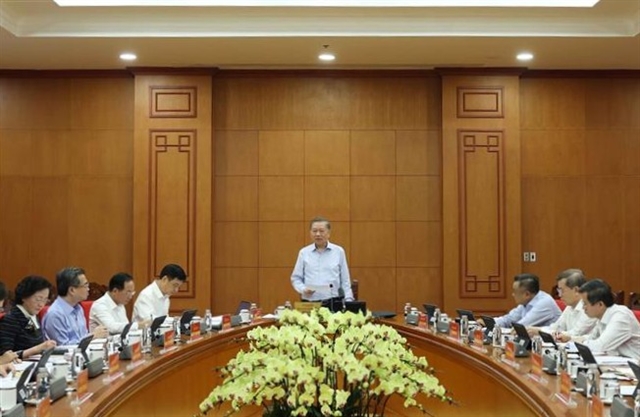 |
| Party General Secretary and State President Tô Lâm addresses a meeting with the Party Central Committee’s Commission for Organisation on the review of Resolution No. 26-NQ/TW in Hà Nội on Wednesday. — VNA/VNS Photo Thống Nhất |
HÀ NỘI — General Secretary of the Communist Party of Việt Nam (CPV) Central Committee and President Tô Lâm has called for fundamental reforms in personnel work, from expanding and diversifying talent sources to strengthening evaluation and data-based governance, to build a high-quality contingent of officials capable of meeting Việt Nam’s development requirements through 2030 and toward 2045.
Addressing a meeting in Hà Nội on Wednesday with the Party Central Committee’s Commission for Organisation on the review of Resolution No 26-NQ/TW, adopted by the 12th Party Central Committee’s 7th plenum in May 2018, the top leader described the resolution as an important strategic policy for building a contingent of officials, particularly those at the strategic level, with strong political qualities, competence and prestige.
He urged an objective assessment of the resolution’s eight-year implementation, with the quality of the personnel contingent and actual outcomes serving as the key measures.
He said the new resolution of the 14th Party Central Committee must retain principles that remain valid while addressing new issues arising from practice. It should not become merely a collection of professional procedures or pursue reform simply for the sake of change.
A key requirement is to shift from managing individual stages of personnel work to comprehensive governance and development of a unified, interconnected personnel system, linking job positions and competency with recruitment, training, placement, evaluation, remuneration and screening.
While proper procedures remain essential, the ultimate goal is to “select the right person for the right position” and ensure results, he stressed, adding that officials should be assigned clear objectives, authority, responsibilities, resources, deadlines and expected outputs, with performance assessed regularly and from multiple dimensions.
He demanded further refining the guiding principles for personnel work, stressing the Party’s unified, direct and comprehensive leadership while ensuring that democratic centralism is matched by clearly defined powers and responsibilities. Decentralisation must go hand in hand with power control.
Evaluation results must be put to substantive use in personnel planning, recruitment, training, placement, reward, discipline and screening. He also stressed that personnel structures must not replace established standards and that continuity and succession between generations must be ensured.
By 2030, Việt Nam should achieve fundamental and substantive changes in personnel work and largely complete the institutional foundations for job positions, competency frameworks, evaluation, personnel development and data-based governance. By 2045, the country should have a contingent of officials capable of meeting the requirements of a high-income developed nation, he said.
The leader stressed the need to make a decisive shift from closed personnel sources to open and diversified ones, with officials prepared early and from afar for key positions, strategic fields, new tasks and difficult areas.
He also stressed that personnel databases must be accurate, complete, up to date, secure and verified to support governance, forecasting, talent identification and risk detection.
Clearer authority and responsibility must be established at every level, he said, stressing that where authority is decentralised, power must be controlled, and where power is granted, responsibility must be assumed.
General Secretary and President Lâm stressed that personnel work ultimately determines the quality of the Party’s leadership, the strength of the political system and the country’s future.
Its effectiveness should be measured not by the number of regulations and procedures, but by whether the right people are selected and placed in the right positions, talent is effectively utilised, underperforming officials are screened out and power is effectively controlled, he said.
He asked the Party Central Committee's Commission for Organisation to continue refining the review report, draft resolution and implementation plan for submission to the Political Bureau and the Party Central Committee as required. — VNA/VNS
Politics & Law
 Politics & Law
 Politics & Law
 Politics & Law
 Politics & Law
 Politics & Law
 Politics & Law
 Politics & Law
 Politics & Law
 Politics & Law
 Politics & Law
 Politics & Law
 Politics & Law
 Politics & Law
 Politics & Law




