 Politics & Law
Vietnamese students place confidence in Việt Nam-China cooperation
1.

|
| Viettel Cyber Security wins 2022 Cybersecurity Excellence Awards. VNA/VNS Photo |
HÀ NỘI — As cybercrime continues to evolve into one of the most pressing transnational security challenges, Việt Nam is increasingly positioning itself as an active contributor to global cyber governance. The country's recent ratification of the United Nations Convention against Cybercrime, widely known as the Hà Nội Convention, marks a milestone in that effort.
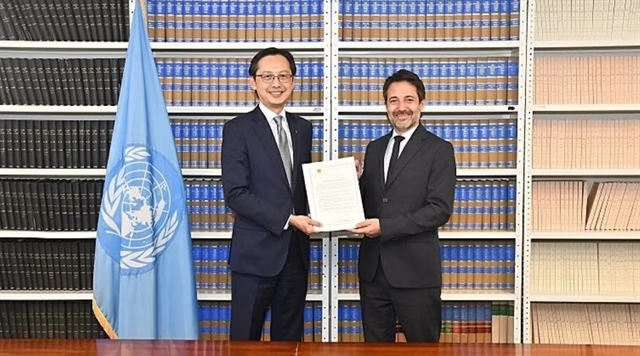
On April 7, Party General Secretary and State President Tô Lâm signed the decision ratifying the convention. Ten days later, Ambassador Đỗ Hùng Việt, Permanent Representative of Việt Nam to the United Nations, officially deposited Việt Nam's instrument of ratification with the UN Office of Legal Affairs in New York.
The move further underscores Việt Nam's leading role in advancing international cooperation against cybercrime, following its central role in negotiating and hosting the convention's signing ceremony in Hà Nội in October 2025.
International experts believe Việt Nam's early ratification sends a strong signal of its commitment to multilateralism and international cyber governance.
Professor Stephen Nagy from Japan's International Christian University said Việt Nam is seeking to demonstrate itself as "a reliable international partner to build multilateral agreements in cyberspace."
"This serves the dual purpose of working with others to deal with destabilising cyber actors abroad and ensuring those actions do not cause socio-economic instability at home," he said, adding that Việt Nam is increasingly positioning itself as a leading cyber actor in Southeast Asia.
"It shows that Việt Nam takes its role as a regional and global stakeholder seriously," Nagy noted, adding that Hà Nội also wants to ensure cyberspace does not become a source of instability affecting national development and governance.
Developing nations' bigger voice in cyber governance
So far, 75 countries have signed the convention, which will formally enter into force once it is ratified by 40 states. While the convention remains open for signatures until December 31, 2026, Professor Carl Thayer of the Australian Defence Force Academy at the University of New South Wales said the required number of ratifications could be secured before the signing period closes, allowing the convention to take effect 90 days later.
However, some analysts noted that geopolitical dynamics could influence the pace at which countries move forward with ratification. According to Nagy, some nations may take additional time to assess the positions and approaches of major powers in cyberspace before making formal commitments to the convention.
The expert said smaller countries, in particular, tend to carefully consider broader strategic implications amid intensifying competition in the cyber domain among major powers. Despite such concerns, experts say the convention could significantly strengthen international confidence in developing countries' ability to shape global governance frameworks. "If the convention is brought into reality, we may see confidence build in countries such as Việt Nam that they can lead international conventions to help shape and stabilise international order," Nagy said.
He held that the Hà Nội Convention challenges the perception that developing countries merely follow rules established by advanced economies. "It demonstrates that developed and developing countries can work together in joint leadership positions to offer public goods to the global community."
Việt Nam's intensified cybersecurity efforts
Việt Nam's push for stronger cyber governance comes amid rapidly growing digital connectivity and rising cyber threats domestically.
According to Hà Văn Bắc, Deputy Director General of the Department for Cybersecurity and High-Tech Crime Prevention, cyberattacks in Việt Nam have continued to grow in both scale and sophistication. In 2025 alone, thousands of cyberattacks targeted government agencies, organisations, and businesses across the country. Ransomware incidents surged sharply, affecting more than 3,000 enterprises.
The official warned that attacks are increasingly targeting not only large corporations but also small and medium-sized enterprises, service providers, and interconnected supply chains, raising the risk of widespread disruption. As of January 2026, Việt Nam had more than 85.6 million internet users, accounting for approximately 84.2 per cent the population and ranking 12th globally in internet usage.
While the rapid expansion of digital connectivity creates enormous opportunities for innovation and economic growth, it also increases demands for cybersecurity, data protection, and international cooperation against high-tech crime. Experts say Việt Nam's proactive engagement in the Hà Nội Convention aligns closely with its broader development orientation in the digital era.
Professor Thayer observed that under the leadership of Party General Secretary and State President Tô Lâm, Việt Nam has accelerated efforts to streamline its political system while pursuing deeper international integration and digital transformation.
According to Thayer, Việt Nam is seeking to shift from an export model primarily based on foreign investment toward one driven by innovation, high technology, and greater domestic value creation.
"Việt Nam's leaders understand quite well that 'business as usual' will lead Việt Nam into the middle-income trap," he said. In that context, experts believe Việt Nam's active role in shaping global cyber norms not only enhances international security cooperation, but also supports the country's ambition to build a secure and resilient digital economy for the future.
In an interview with the Việt Nam News Agency, Major General Lê Xuân Minh, Director of the Department of Cybersecurity and High-Tech Crime Prevention under the Ministry of Public Security, said the convention captures entirely new challenges facing today's society and the global community. As such, translating it into domestic law to enable countries to ratify and jointly implement its commitments is critically important.
"I believe that for the convention to be implemented effectively, it is essential to further refine the legal framework and raise awareness from the highest levels of government to every individual - those who engage in cyberspace on a daily basis. Only with broad-based participation can the convention deliver its full impact."
Nguyễn Đặng Thắng, Director General of the Department of International Law and Treaties at the Ministry of Foreign Affairs, said the Ministry of Public Security will act as the lead agency to operationalise the convention in Việt Nam. Following the signing, countries will move to ratification, during which Việt Nam will review and refine its domestic legal framework to support the implementation, according to Thắng.
"We have a solid track record in implementing previous conventions, recognised by the international community, which gives Việt Nam a strong advantage," he said.
Alongside efforts to consolidate the legal framework, Vietnamese authorities in recent years have stepped up crackdowns on a number of particularly serious online fraud cases.
Notably, Hà Nội police have dismantled high-profile cases that drew widespread public attention, including those involving Phó Đức Nam (also known as Mr Pips), Lê Khắc Ngọ (Mr Hunter), and 73 other defendants in a case of fraud and money laundering. Significantly, following the signing of the Hà Nội Convention, authorities were able to identify and recover assets linked to the Mr Pips group in Singapore and Australia.
Permanent Deputy Foreign Minister Nguyễn Minh Vũ said that while Việt Nam's technological capabilities and capacity to tackle cybercrime may lag behind those of more developed countries, it has taken a proactive lead, demonstrating the strong resolve and commitment of a developing nation ready to stand at the forefront alongside the international community in addressing urgent cybersecurity challenges. — VNA/VNS
Politics & Law
 Politics & Law
 Politics & Law
 Politics & Law
 Politics & Law
 Politics & Law
 Politics & Law
 Politics & Law
 Politics & Law
 Politics & Law
 Politics & Law
 Politics & Law
 Politics & Law
 Politics & Law
 Politics & Law