 Politics & Law

Deputy PM asks for highest education quality, safety for students
1.
|
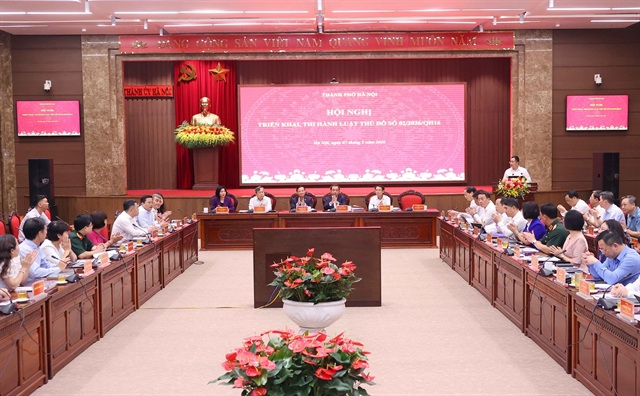
| The conference on the Capital Law on Thursday. — VNA/VNS Photo |
HÀ NỘI — Hà Nội is set to gain sweeping new powers over finance, urban development and the civil service under a landmark law passed last month, as national and city officials met on Thursday to discuss how the legislation will be implemented.
The Capital Law, approved on April 23 by the 16th National Assembly at its inaugural session, grants Hà Nội authorities that go beyond those held by other Vietnamese cities and provinces. Officials said the legal framework would help position the capital for faster and more sustainable growth in the coming years.
Deputy Minister of Justice Nguyễn Thị Thanh Tú, speaking at the conference attended by National Assembly Vice Chairman Nguyễn Khắc Định, described the law as a breakthrough in governance, development strategy and urban planning.
Under the legislation, Hà Nội will be allowed to develop policies and mechanisms tailored to its own development priorities, giving city authorities greater autonomy over administration and management.
The law also encourages the capital to pursue new economic models instead of relying on approaches that shaped growth in previous decades.
In terms of urban planning, the legislation broadens the framework for regional integration, allowing Hà Nội to strengthen links with neighbouring provinces and cities. It also introduces regulations covering the development of underground space and low-altitude airspace, with provisions for higher-altitude development expected later.
Financially, Hà Nội will retain 100 per cent of bonuses earned for exceeding annual budget targets, instead of sharing them with the central government. The city is also authorised to issue bonds, including green bonds and project-specific instruments and to approve major investment projects that previously required approval from the National Assembly or the Prime Minister.
The law further expands the city’s authority to generate revenue from public infrastructure by allowing certain facilities to be leased or franchised for reinvestment purposes.
To attract skilled workers into public service, Hà Nội will be permitted to offer competitive salaries, housing support and upgraded training facilities, while also bringing in outside experts to advise on complex development issues.
Housing policy benefits under the legislation will apply to both city civil servants and central government employees based in Hà Nội.
Among the law’s more forward-looking provisions is a framework for transit-oriented development, or TOD. The legislation also establishes a controlled regulatory sandbox, enabling the capital to pilot new approaches to governance and urban management before wider implementation.
Chairman of the Hà Nội People’s Committee Vũ Đại Thắng said the city moved quickly after the law was passed, issuing implementation directives almost immediately and making enforcement a political priority across all levels of government.
He called for clear accountability within each agency, with department leaders held directly responsible for outcomes.
"The implementation process must follow the principle of clarity – clear people, clear tasks, clear timelines, clear responsibilities, clear deliverables, clear authority," Thắng said.
He added that officials who delayed implementation, avoided responsibility or shifted blame would face strict consequences.
Thắng said the Capital Law should be viewed alongside two other major policy documents: a 100-year master plan for Hà Nội and Politburo's Resolution 02 on the capital’s development in the new era. He described the three documents as mutually reinforcing foundations for the city’s long-term growth.
Regional coordination was also a key topic at Thursday’s meeting, with officials stressing that Hà Nội must work closely with neighbouring provinces and cities to ensure the law’s provisions on inter-regional connectivity are implemented consistently.
The city also announced plans for a public information campaign to familiarise residents and officials with the new legislation through print, broadcast and digital platforms, as well as infographics, short-form videos and podcasts. — VNS
Politics & Law
 Politics & Law
 Politics & Law
 Politics & Law
 Politics & Law
 Politics & Law
 Politics & Law
 Politics & Law
 Politics & Law
 Politics & Law
 Politics & Law
 Politics & Law
 Politics & Law
 Politics & Law
 Politics & Law