 Politics & Law
Vietnamese Prime Minister meets Cambodian National Assembly President
1.
|
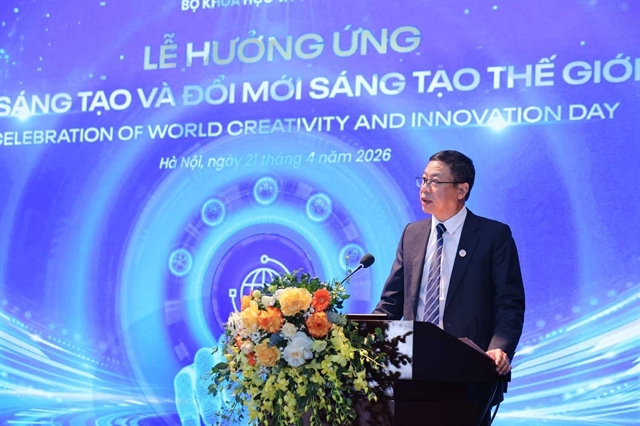
| Deputy Minister of Science and Technology Lê Xuân Định speaks at the event celebrating the World Creativity and Innovation Day in Hà Nội on Tuesday. — VNA/VNS Photo Hoàng Hiếu |
HÀ NỘI — Innovation demands the engagement of the public and the whole nation, said Deputy Minister of Science and Technology Lê Xuân Định at an event on the World Creativity and Innovation Day (April 21) on Tuesday in Hà Nội.
Initiated by the United Nations (UN), this day aims to promote the spirit of innovation among society and promote the transformation from awareness to action. It also mobilises resources and implements innovative activities across all sectors and industries, organisations and individuals, to foster a culture of innovation.
For Việt Nam, this is also an occasion to reaffirm the determination of the Party, State and the entire society in carrying out the Politburo’s Resolution 57 as well as the official document from the 14th National Party Congress.
Both place science, technology, innovation and digital transformation as the pillars of national development.
Speaking at the event, Deputy Minister Định said: “This is an opportunity for us to reaffirm a shared understanding of the times, that innovation has become a key driving force for development, a decisive factor in the competitiveness and position of each nation in the new era.”
The World Creativity and Innovation Day is a reminder that creativity is not the privilege of a select few and innovation is not the responsibility of a single sector, he said, stressing that this is the mission of the entire nation.
A nation that wants to make rapid progress in this era must know how to organise itself to leverage, connect and transform all creative resources into concrete growth results, he added.
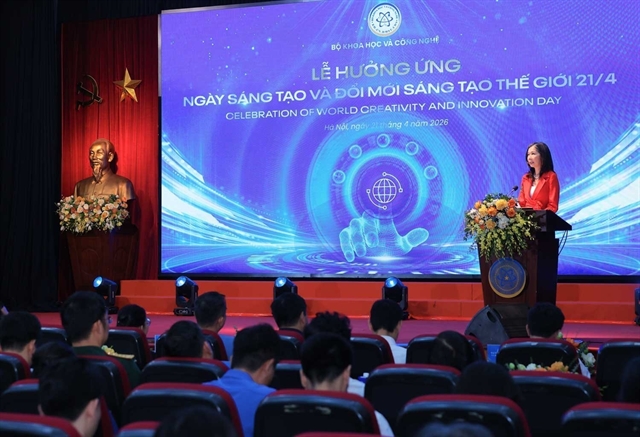
UN Resident Coordinator in Việt Nam Pauline Tamesis said: “Việt Nam has always been a nation of resilience, ingenuity, and vision. Today, it stands ready not only to innovate but to inspire.
“So let us make this day more than a celebration. Let us invest in people, connect ideas, and share digital opportunities for all. Let us commit – governments, innovators, educators and young leaders alike – to turning creativity into solutions, and ideas into impact.
“Việt Nam can become not only a frontrunner in innovation, but a global beacon of creativity.”
|
| Pauline Tamesis, United Nations Resident Coordinator in Việt Nam, addresses the event in Hà Nội. — VNA/VNS Photo Hoàng Hiếu |
This year’s event is held against the backdrop of an increasingly synchronised and unified legal system regarding science, technology and innovation. The foundations for a national innovation system have taken shape, while the innovative startup ecosystem continues to expand and improve with enhanced connectivity.
This is considered a favourable time for a shift from institutional reform to effective implementation, promoting innovation, creating added value and making direct contributions to socio-economic growth.
The Ministry of Science and Technology has chosen the themes of this year’s World Creativity and Innovation Day as 'Innovation – Create breakthroughs, spread results' and 'Innovation – Transform faster, stronger to turn ideas into value, aspirations into reality'.
These two themes emphasise the need for a strong shift from awareness to decisive action, creating concrete results with the potential for widespread impact throughout society.
They also called for accelerated progress, improved organisational capacity, and a shorter route from idea to application and commercialisation.
The themes affirm the role of innovation as a key driving force, contributing to the realisation of the country's aspiration for rapid and sustainable development.
Within the framework of the event in Hà Nội, a forum on developing innovation centres was held to provide a space for experts to discuss the role, organisational models, operating mechanisms and policy implementation for innovation hubs in Việt Nam.
The spirit of innovation, as stated in Resolution 57, is evident and consistent throughout the event, particularly with the emphasis on shifting from institutional improvement to effective implementation.
Identifying innovation as a pillar of development, a key driver of productivity-based growth, and mobilising the participation of the entire system shows that Resolution 57 not only provides direction but also focuses on substantive action, linking innovation with solving development issues. — VNS
Politics & Law
 Politics & Law
 Politics & Law
 Politics & Law
 Politics & Law
 Politics & Law
 Politics & Law
 Politics & Law
 Politics & Law
 Politics & Law
 Politics & Law
 Politics & Law
 Politics & Law
 Politics & Law
 Politics & Law