 Op-Ed
Op-Ed
.jpg)
SHB unveils sustainable finance framework to expand green and social lending
1.
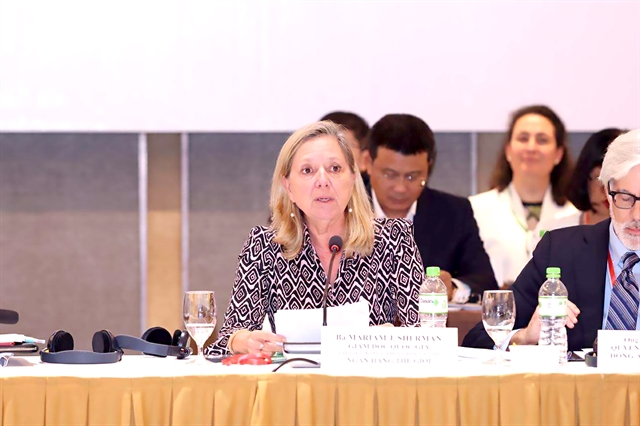 |
| Mariam J. Sherman, Division Director for Việt Nam, Cambodia and Lao PDR, speaks at the Annual Vietnam Business Forum 2025 on Monday. Photo VPF |
Mariam J. Sherman*
The recent announcement by FTSE Russell on Việt Nam’s upgrade to emerging market status is highly encouraging. This is more than a technical classification, it signals stronger international confidence and opens the door for long-term foreign capital to flow into productive sustainable investments across Việt Nam’s economy. It is a remarkable milestone, the result of persistent reforms and the growing recognition that Việt Nam’s progress is real and tangible.
Yet, a challenging development journey lies ahead. The key question now is: How can Việt Nam pursue fast, sustainable and inclusive growth to achieve its high-income aspirations by 2045?
Việt Nam stands at a pivotal moment, one where it can evolve into a greener, more competitive and more future-ready economy. In this next phase, the private sector, both domestic enterprises and foreign investors, will be the decisive engine of productivity and innovation. Ongoing reforms, including those under Resolutions 68 and 66 to cut red tape, streamline and digitalise licensing and enhance regulatory predictability, are steps in the right direction. Staying the course will nurture more Vietnamese firms that scale up, innovate and integrate deeply into global value chains.
If more domestic firms can link to this dynamic part of the economy, Việt Nam can unleash a new wave of productivity and creativity.
But what does it take to truly promote private sector development in Việt Nam?
The first part of the answer lies in people and partnerships, upgrading workforce skills and strengthening the linkages between domestic and foreign-invested firms. Currently, workers in FDI firms are around 70 per cent more productive and earn nearly 50 per cent higher wages than those in comparable domestic firms. Meanwhile, only one in six domestic firms is connected to global markets. This gap represents not only a challenge but also a tremendous opportunity for technology transfer, learning and innovation.
Building stronger ties between FDI and local suppliers, through supplier development programmes, higher quality standards and effective matchmaking, can accelerate the spread of know-how. This is how Việt Nam can move from assembling products to designing and engineering them.
At the same time, preparing a future-ready workforce is vital. Only about 5.6 per cent of manufacturing workers today have high-level skills, and the average Vietnamese manufacturing worker produces about US$6.70 of value added per hour, compared to $14.40 in China. Closing that gap is within reach. Modernising curricula for digital and 21st-century skills, expanding STEM and demand-driven vocational training, promoting apprenticeships and strengthening public-private partnerships in education and training will pay enormous dividends.
Investing in people is the best industrial policy.
A thriving private sector also depends on quality infrastructure, transport, energy and climate-resilient urban systems, which will require diversified and large-scale financing. Việt Nam’s ambitions demand major well-prioritised investments across these sectors.
Take energy as an example: electricity demand is expected to grow by nearly 9 per cent annually from 2025, implying a doubling of today’s 78 GW installed capacity every decade, along with a massive expansion and modernisation of the transmission grid.
While private investors will drive much of this infrastructure push, the public sector’s enabling role remains indispensable. Strategic planning, stable policies and strong capital market institutions are essential to create conditions that allow private capital to scale into infrastructure and renewable projects.
Finally, investor confidence, both at home and abroad, remains the cornerstone. Confidence relies on predictable rules, stable tax regimes, a visible pipeline of transparent bankable projects, fair risk-sharing and deep well-regulated capital markets. With these foundations, firms will invest boldly, and innovation will thrive, while the public sector continues to set direction and remove bottlenecks.
As highlighted at the Vietnam Business Forum earlier this week, partners including the World Bank Group stand ready to help mobilise capital, structure bankable transactions and deepen capital markets, so that more private investment can power Việt Nam’s journey toward green, resilient and competitive growth. VNS
*Mariam J. Sherman is the World Bank Division Director for Việt Nam, Cambodia and Lao PDR
Op-Ed
 Op-Ed
Op-Ed
 Op-Ed
Op-Ed
 Op-Ed
Op-Ed
 Op-Ed
Op-Ed
 Op-Ed
Op-Ed
 Op-Ed
Op-Ed
 Op-Ed
Op-Ed
 Op-Ed
Op-Ed
 Op-Ed
Op-Ed
 Op-Ed
Op-Ed
 Op-Ed
Op-Ed
 Op-Ed
Op-Ed
 Op-Ed
Op-Ed
 Op-Ed
Op-Ed