 Life & Style
Ministry proposes allowing foreign investors to participate in market infrastructure
1.
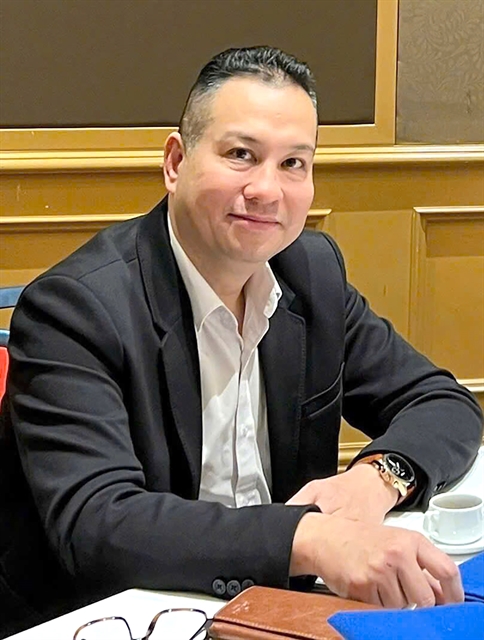 |
| Translator Nguyễn Đức Dũng. Photo coutersy of Nguyễn Đức Dũng |
Translator Nguyễn Đức Dũng has taught translation and English–Vietnamese interpretation for 28 years at universities as a guest lecturer. Alongside his professional work, Dũng is an avid painter and recently held his first solo exhibition at the Việt Nam Fine Arts Museum. Việt Nam News reporter Nguyễn Bình sat down with Dũng to discuss his artistic and literary contributions.
-----
You recently held your first solo exhibition at the Việt Nam Fine Arts Museum. What are the main themes and ideas behind the paintings on display?
The theme of my first solo exhibition, The Translator, conveys the message that I do not simply translate semantics. Instead, I turn meaning, culture and knowledge into visual language, giving them shape and texture. This process helps me share my insights and perspectives on the world, nature, humanity and the things around us.
How did you get started in painting?
I learned basic drawing skills when I was young. I recently took up painting again after translating several books.
Through years of reading, I have come to understand that the world is changing so quickly and in ways we have never experienced before.
I then began teaching myself through social media, where I met 12 experts from around the world, such as artist Rinske Douna, who offered online courses for beginners on basic sketching and composition, as well as how to use tools and materials. This was the first phase.
Later, I met with five other contemporary artists, such as Joanna Green, Fredy Villamil and Aziz Sulaymanov, who provided training in abstract art, cubism and expressionism. These opportunities came to me through my experience in teaching and working as a translator, along with taking notes, practising and taking part in discussions.
Walk us through your typical painting routine.
I keep a strict “30-3” rule under which I spend 30 hours on thinking and three hours on painting.
Normally, I paint four days a week and reschedule my teaching for the following week. I like to paint in the morning because the day is fresh and I prefer to find a quiet pace at which I can concentrate.
How does your translation work influence your painting, and vice versa?
I think painting helps me relax. Of course, it takes hard work, but I find it really interesting.
Translation taught me the patience and curiosity. Painting teaches me how to express my perspectives on nature, humanity and my imagination.
The exhibition also features 19 books that you translated. What should readers know about your translation work?
In the past six years, I have completed translations of books and documents about digital transformation from English to Vietnamese. The aim is to bring global knowledge and expertise about digital technologies to local communities.
This event was my opportunity to show my family, friends and community the work that I have done so far. I make these contributions with the hope that readers will better understand changes in society driven by technological advancements.
People can then respond and adapt to these changes, as well as recognise the risks and threats posed by those who misuse technology.
You spent six years translating these books. What prompted you to undertake these projects?
Digital transformation has advanced rapidly in countries around the world. It goes beyond society, government and the economy. Digital technology can be a tool that creates shared opportunities for people to access and exchange resources and expertise, and even do business.
That is why I selected books and documents related to lifelong learning, new skills, digital supply chains, green finance and technology to translate into Vietnamese for local readers.
What role can digital transformation play in cultural development in line with the Party's Resolution 80?
Digital transformation plays an important part, particularly in communication, by helping to quickly share cultural values with people inside and outside the country. It can make a strong impression on viewers, especially when heritage is presented in the digital space.
I think it also creates opportunities for business and tourism, which will attract more visitors to Việt Nam.
However, content creators must be capable of coming up with ideas and content in line with good practice, as they share the country's culture. They must also continually improve their own skills. — VNS
Life & Style
 Life & Style
 Life & Style
 Life & Style
 Life & Style
 Life & Style
 Life & Style
 Life & Style
 Life & Style
 Life & Style
 Life & Style
 Life & Style
 Life & Style
 Life & Style
 Life & Style