 Economy

Deputy PM urges stronger market links, agro-seafood exchange establishment
1.
 |
| Deputy Prime Minister Phạm Thị Thanh Trà chairs an online meeting with nine northern provinces on Wednesday. — VNA/VNS Photos An Đăng |
HÀ NỘI — Deputy Prime Minister Phạm Thị Thanh Trà on Wednesday urged nine northern provinces to step up efforts to achieve double-digit economic growth, accelerate public investment and address bottlenecks in local administration.
She made the call during an online meeting with provincial authorities to review socio-economic development and implementation of government policies.
The meeting brought together representatives from Lào Cai, Phú Thọ, Lai Châu, Điện Biên, Sơn La, Thái Nguyên, Tuyên Quang, Cao Bằng and Lạng Sơn provinces.
Despite positive progress in economic and social development, the provinces continued to face significant challenges in meeting the country's growth targets, Trà said.
She stressed the region’s importance to national security, economic development and environmental conservation.
Unlocking the region's potential would help support Việt Nam's economic restructuring and shift towards a more sustainable growth model, while narrowing development gaps between mountainous areas and more prosperous regions, she said.
Trà highlighted Thái Nguyên and Phú Thọ as emerging growth drivers, but urged all nine provinces to propose concrete and feasible measures to meet their 2026 targets and sustain growth in the years ahead.
She identified three priorities, including achieving double-digit growth, speeding up public investment disbursement and improving the operation of the two-tier local government system.
Public investment was particularly important not only for completing infrastructure projects but also for stimulating economic activity and boosting regional and national output, she said.
Provincial authorities also needed to address staffing and organisational problems, particularly at the commune level, improve the delegation of powers, manage surplus public assets, allocate sufficient funding and accelerate digital transformation.
Deputy PM Trà called for urgent progress in defining job positions across the political system and public service units. The work must be completed in the remaining two months of the year to provide a basis for determining staffing levels for 2027-2031 and support planned salary reforms, she said.
Growth outpaces national average
The region's gross regional domestic product (GRDP) grew 9.43 per cent in the first nine months of 2026, above the national average of 9.01 per cent, according to the Ministry of Finance. It accounted for 8.5 per cent of Việt Nam's total economic output, with Thái Nguyên and Phú Thọ the only provinces recording growth above 10 per cent.
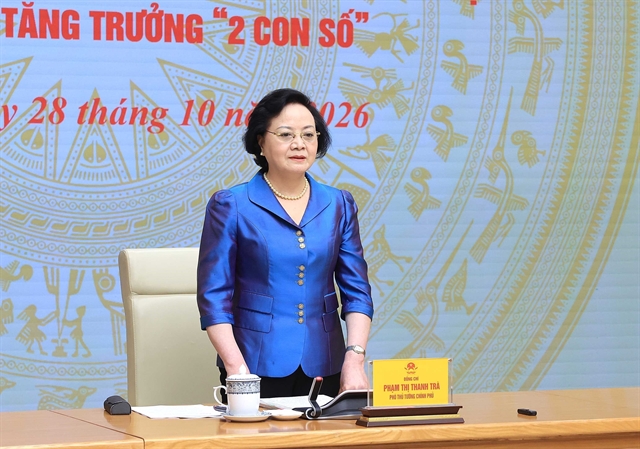 |
| Deputy Prime Minister Phạm Thị Thanh Trà speaking at the meeting. |
Industry and construction grew 13.03 per cent, contributing about 57 per cent of regional growth, while agriculture, forestry and fisheries also outperformed the national average.
Import-export turnover reached US$193 billion by October 15, or 20.4 per cent of the national total. Registered foreign direct investment stood at $9.68 billion, accounting for 19.2 per cent nationally. Thái Nguyên attracted about $8 billion, ranking second after HCM City.
Domestic private businesses launched 271 projects worth more than VNĐ334 trillion ($12.9 billion), including 32 valued at over VNĐ3 trillion each.
State budget revenue reached VNĐ138 trillion by October 25, equivalent to 99.27 per cent of the annual target. Import-export revenue totalled VNĐ33.5 trillion, or 146 per cent of the estimate.
Growth remained below target and was concentrated in a few provinces.
Phú Thọ and Thái Nguyên accounted for 56.4 per cent of regional output, while many other provinces remained dependent on agriculture, mining and hydropower.
Provinces had largely completed preparations for the two-tier local government system, including office arrangements, public asset transfers and budget allocations.
However, the changes increased workloads at commune level, while staffing and administrative capacity remained limited, particularly in remote mountainous and border areas. — VNS
Economy
 Economy
 Economy
 Economy
 Economy
 Economy
 Economy
 Economy
 Economy
 Economy
 Economy
 Economy
 Economy
 Economy
 Economy




