 Economy

EVNNPT seeks over $224 mln in bank loans for grid expansion
1.
|
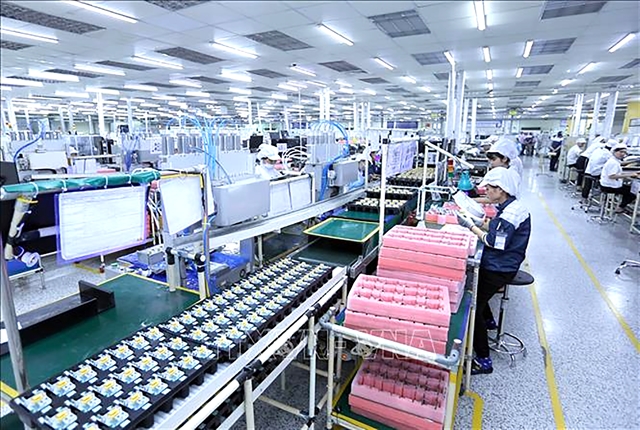
| An electronic circuit board production line at Nexcon Vietnam Company Limited, a RoK-invested company in Bắc Ninh Province. — VNA/VNS Photo |
HÀ NỘI — The global shift in supply chains is creating new requirements for the technical infrastructure of foreign direct investment (FDI) projects in Việt Nam, particularly in electronics and semiconductors, data centres and pharmaceuticals.
Investors and main contractors are increasingly looking beyond individual equipment purchases towards integrated systems that can perform efficiently throughout a project's life cycle.
According to businesses in the supporting industries, the requirements of next-generation FDI projects have changed significantly.
The development of industrial facilities and high-tech factories is no longer limited to selecting individual equipment or separate suppliers for different work packages. Investors are increasingly seeking the integration of building structures, MEP systems, power and energy, automation and HVAC/RHVAC, as well as cleanroom and environmental-control technologies.
Project performance is also being assessed across the life cycle of a facility, from design and construction to testing, commissioning, operation, maintenance and energy efficiency optimisation.
A representative of an EPC contractor specialising in electronics factories in Bắc Ninh said semiconductor and high-tech component projects have particularly stringent requirements for ventilation, air conditioning and particle control in cleanrooms. Even a small deviation can result in defective product batches and significant losses.
The representative said one of the challenges was finding subcontractors and material suppliers capable of coordinating different systems within the same project. An ecosystem-based approach can help contractors shorten the time needed to identify and assess suitable suppliers.
Energy and environmental pressures
Energy costs and environmental requirements are also becoming increasingly important in factory investment and operation.
Against a backdrop of rising energy costs and tighter global requirements on environmental standards and carbon emissions, including the Carbon Border Adjustment Mechanism, greener manufacturing is becoming a top priority.
This is drawing greater attention to HVAC, MEP, cooling, renewable energy and energy data management solutions, both during the investment stage and throughout facility operations.
Experts note that HVAC and MEP systems can account for up to 50 per cent of a factory's total electricity consumption. Smart cooling solutions, renewable energy integration and energy data management are therefore increasingly relevant to efforts to optimise operating costs and improve competitiveness.
These requirements are particularly significant for facilities with strict standards for temperature, humidity, cleanliness and production environments, including semiconductor and pharmaceutical plants and data centres.
As industrial projects become more technically integrated, investors and contractors need to connect with suppliers capable of meeting specific requirements across multiple systems and project stages. This creates a need for industry platforms that can bring project owners, contractors and specialised suppliers together, not only to showcase products but also to facilitate discussions around actual project requirements.
These increasingly integrated requirements are also creating a need for stronger connections between investors, contractors and specialised suppliers.
Against this backdrop, Viet Industry – Cleanfact & RHVAC Vietnam 2026 will focus on connecting industrial buyers, including investors, main contractors and EPC/MEP contractors, with suppliers through business-matching activities. According to the organisers, procurement demand recorded ahead of the event has exceeded VNĐ1 trillion (US$38.4 million) for projects planned in 2026–27.
Scheduled for September 16–18 at the Vietnam Exhibition Centre in Đông Anh, Hà Nội, the event will bring together companies and technologies covering industrial infrastructure, MEP, HVAC/RHVAC, cooling, cleanrooms and environmental control, alongside business-matching activities and technical seminars.
It is intended to provide a platform for industry players to explore solutions and partnerships for the growing technical requirements of industrial and high-tech projects in Việt Nam. — VNS
Economy
 Economy
 Economy
 Economy
 Economy
 Economy
 Economy
 Economy
 Economy
 Economy
 Economy
 Economy
 Economy
 Economy
 Economy