 Economy

Việt Nam, Denmark issue joint statement on establishment of Comprehensive Strategic Partnership
1.
|
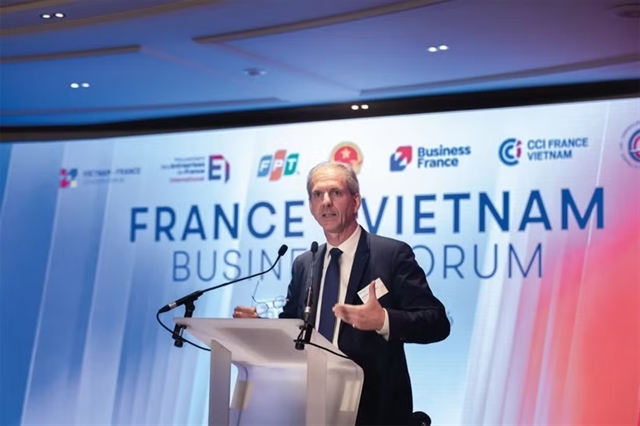
| Chairman of the France–Vietnam Business Council Benoit Clocheret. — Photo published by VNA |
PARIS — The official visit to France by General Secretary of the Communist Party of Vietnam Central Committee and President Tô Lâm is expected by the French business community to provide fresh momentum for cooperation, amid a high level of Việt Nam-France political ties and unprecedented confidence among French businesses in Việt Nam.
In an interview with the Vietnam News Agency (VNA) correspondents in Paris ahead of the visit, Benoit Clocheret, Chairman of the France–Vietnam Business Council, who is also Vice President of MEDEF International – the global outreach arm of the Movement of the Enterprises of France (MEDEF) and Chief Executive Officer of Artelia Group, said the French business community attaches great importance to the visit and its economic significance.
He said the council works to strengthen connections between businesses of the two countries and promote exchanges between enterprises and authorities. Clocheret expects the visit to further consolidate bilateral ties and serve as a “catalyst” for accelerating joint projects.
He recalled Party General Secretary Tô Lâm’s visit to France in October 2024, saying it marked the elevation of bilateral ties to a Comprehensive Strategic Partnership. French President Emmanuel Macron’s state visit to Việt Nam in May last year subsequently resulted in 15 agreements and contracts worth about 9 billion EUR (US$10.2 billion), covering aviation, civil nuclear power, railways, Earth-observation satellites and vaccines.
Clocheret said MEDEF International aims to help bring more projects into implementation. Artelia, which has been present in Việt Nam for 20 years, is one example. Early this year, the group signed a contract with the Ministry of Construction to support the preparations of studies for the North-South high-speed railway.
He said France has comprehensive industrial capabilities in infrastructure and energy, backed by strong financial instruments. Combined with longstanding high-level political ties, these strengths create favourable conditions for the visit to generate positive results for businesses and support Việt Nam’s ambitious development goals.
Railways are among the most promising areas for cooperation. Clocheret cited Hà Nội’s Metro Line 3 as a successful project involving French businesses and financing. France can contribute across the railway project chain, from system design, signalling and safety certification to rolling stock supply, operation, maintenance and human resource training. Such expertise, he said, will be valuable for the North-South high-speed railway.
Energy is another priority, as rapid economic growth is increasing Việt Nam’s energy demand and requiring upgrades to its power system. French companies can expand cooperation in the sector, including nuclear power, a strategic priority of Việt Nam, he noted.
As Việt Nam restarts its civilian nuclear power programme, France is among the few countries with capabilities across the nuclear value chain, including plant operation, reactor equipment, fuel cycles, engineering, training and nuclear safety regulation.
Clocheret also highlighted civil aviation, health care and the digital economy as areas with substantial potential. In health care, French businesses can expand cooperation in vaccines, medical equipment, management, training and digital technologies.
In the digital economy, French businesses share Việt Nam’s development priorities, including its goal of having the digital economy account for at least 50 per cent of GDP by 2045. Cooperation should focus not only on transferring French technologies but also on jointly building a technology ecosystem, he said.
Essential materials and space are also potential areas of cooperation. Across these sectors, thousands of technicians and engineers will need to be trained. He said training has long been a strength of French business cooperation and could become an important lever for bilateral ties.
Regarding conditions for boosting economic and investment cooperation, Clocheret said confidence among French businesses in Việt Nam is now at its highest level ever. Reforms since 2025 to streamline administrative procedures, improve the legal framework and strengthen the private sector have created positive prospects.
However, he stressed that a stable and predictable business environment remains crucial for long-term investment. French businesses hope to continue discussing the need to shorten the time for handling administrative procedures, improve legal clarity and stability, and facilitate financing for major projects during the top Vietnamese leader’s visit.
Clocheret also welcomed progress in the ratification of the EU-Vietnam Investment Protection Agreement (EVIPA), which has been submitted to the French Parliament for consideration. The agreement, he said, will provide a more favourable framework for French businesses investing in Việt Nam. — VNA/VNS
Economy
 Economy
.jpg) Economy
Economy
 Economy
 Economy
 Economy
 Economy
 Economy
 Economy
 Economy
.JPG) Economy
Economy
 Economy
 Economy
 Economy
 Economy