 Economy



PM Hưng meets with Cambodian People's Party, Senate leader Hun Sen
1.
|
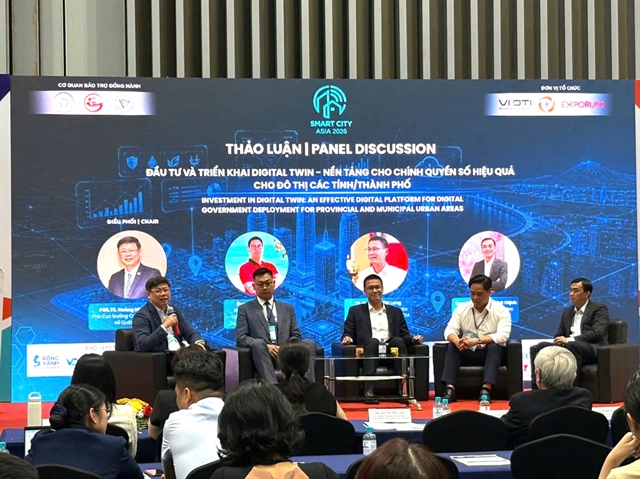
| Panellists at a seminar titled “Digital Twins for Smart City Development” held in HCM City on May 6. — Photo courtesy of the organisers |
HCM CITY — Data, artificial intelligence and digital twin technology are playing a growing role in smart city development in Việt Nam, experts said at the 5th National Forum on Emerging Technologies for Smart and Sustainable City Development held in HCM City last week.
They said smart cities are entering a new phase, moving beyond the digitalisation of public services towards real-time analysis, forecasting and data-driven urban governance powered by AI and big data.
At the forum, Deputy Minister of Science and Technology Lê Xuân Định said Việt Nam is refining its legal framework for smart city development through major policies, including Decision 950/QD-TTg on sustainable smart city development, Resolution 06-NQ/TW, Politburo Resolution 57, and Government Decree 269/2025/ND-CP on smart city development.
“These policies demonstrate the Government’s strong commitment to promoting digital transformation, modernising urban governance, and improving people’s quality of life.
“Technology is not merely a tool, it is the core driver of urban intelligence. Without core technologies, smart cities would remain limited to process digitisation rather than achieving automated analysis, forecasting, and optimisation.”
But he admitted that smart city development still faces several bottlenecks like fragmented data among localities and departments and intelligent operation centres failing to fully utilise AI and big data.
Many cities also still lack digital twin platforms for urban simulation and forecasting, he said.
To address these challenges, the ministry proposed focusing on certain priorities like promoting “dual transformation” in green and digital development, establishing unified data standards, research into AI, big data and digital twin technologies, encouraging sandbox mechanisms for emerging technologies, developing high-quality human resources, and ensuring data security.
Dr Nguyễn Thị Bích Lan, director of the Việt Nam Institute of Digital Transformation and Innovation, said information and communication technology architecture serves as the “backbone” connecting systems, data and services, ensuring interoperability and scalability across the smart city ecosystem.
Digital Twin gains momentum
Experts said digital twin technology is emerging as a key platform for data-driven urban governance, enabling cities to simulate and manage systems in real time through data, AI and intelligent computing.
They noted that digital twins can replicate physical systems in digital space to support decision-making and urban operations, including traffic, lighting, drainage, environmental monitoring and security management.
Discussions also focused on global and domestic development trends, technology architecture from data infrastructure to application layers, and implementation models suited to local conditions.
Representatives from Huawei introduced the concept of the “AI City”, where AI acts as a “digital brain” supporting urban governance.
According to the company, AI systems can automatically detect traffic congestion, flooding, illegal parking and structural safety risks, helping authorities improve forecasting and reduce response times.
|
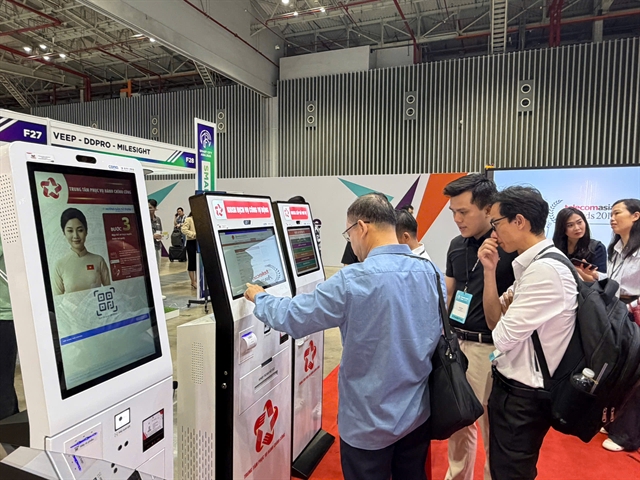
| A booth showcasing automated public service kiosks at the Smart City Asia expo being held at the Saigon Exhibition and Convention Centre in HCM City from May 6 to 8. — Photo courtesy of the organisers |
Officials from the HCM City Department of Construction outlined the progress in developing sectoral databases, implementing digital transformation initiatives, and building smart city infrastructure, with digital twin identified as a strategic breakthrough.
The city aims to complete 19 mandatory databases by the third quarter of 2026. Several major systems are already operational, including databases related to vehicle inspection, construction pricing, water supply and drainage, transport infrastructure, and administrative procedures, they said.
HCM City has also developed GIS-based shared data systems for flood mapping, urban infrastructure, and green space management to support urban operations.
The city has deployed more than 1,300 AI-integrated cameras and sensors to analyse traffic conditions and optimise traffic control.
Built on a Data Lake platform, HCM City is developing digital twin models for transport systems and urban infrastructure to simulate operational scenarios and support decision-making before real-world implementation.
Combined with building information modelling (BIM), the city aims to establish a comprehensive digital construction database. — VNS
Economy
 Economy
 Economy
 Economy
 Economy
 Economy
 Economy
 Economy
 Economy
 Economy
 Economy
 Economy
 Economy
 Economy
 Economy