 Economy



Vietnamese Prime Minister meets Cambodian National Assembly President
1.
|
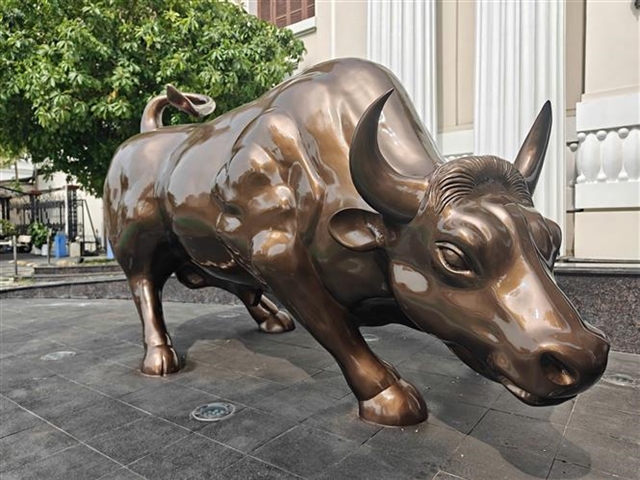
| A bull statue is displayed outside the headquarters of the Hochiminh Stock Exchange. — VNA/VNS Photo |
HÀ NỘI — The stock market is entering May in a sensitive phase, with the VN-Index hovering near high levels driven largely by heavyweight stocks, while capital flows show signs of concentration and limited breadth across sectors.
The benchmark index is currently testing the resistance zone of 1,900-1,920 points. However, declining liquidity and negative market breadth suggest a divergence pattern, reflecting cautious investor sentiment as gains remain unevenly distributed.
Technical signals are also raising concerns. Analysts point to the emergence of a bearish engulfing candlestick pattern on the chart, a formation often associated with potential short-term reversals.
Margin lending has become another key factor. Outstanding margin debt is at record highs, even as trading value shows signs of cooling.
First-quarter financial results from securities firms indicate that lending activities, particularly margin financing, contributed significantly to both revenue and profit among leading brokerages.
In periods of market stress, elevated margin levels can amplify volatility. When stock prices decline sharply, margin accounts may breach maintenance thresholds, triggering margin calls and forced liquidations.
This dynamic was evident in previous corrections, including the March 9 session, when the VN-Index dropped by 115 points, marking its steepest single-day fall on record.
External factors are also adding to uncertainty. Rising geopolitical tensions in the Middle East, particularly around the Strait of Hormuz, have supported higher oil prices and contributed to cautious sentiment in global markets.
The combination of a high index level, weak market breadth, declining liquidity and elevated margin creates a backdrop that calls for caution.
As the market approaches May, investor sentiment is also influenced by the seasonal 'Sell in May' effect. However, historical data suggests that the pattern is not consistent, with many May periods in past years still recording gains.
Lương Duy Phước noted that the phenomenon should not be viewed as a fixed rule. He said May often follows the earnings season and annual general meetings, when supportive information becomes less abundant. In such conditions, short-term profit-taking pressure is not unusual, particularly after index gains driven by a limited number of large-cap stocks.
"Downside risk is not too high at the moment, but short-term volatility is difficult to avoid," Phước said.
"The index appears to have risen rapidly, but that increase has not been evenly distributed. The contribution from the Vingroup-related stocks has been significant in keeping the VN-Index at elevated levels, while many other stocks are still moving sideways or consolidating."
He added that any correction pressure would likely be more visible at the index level, especially if large-cap stocks begin to lose momentum. Meanwhile, because many other stocks have not experienced excessive gains, the broader market’s downside risk remains relatively contained.
Market dynamics are currently shaped by the absorption of information from first-quarter earnings reports and annual general meetings. This has created a divergence in performance, where the index may show positive movement while individual portfolios do not necessarily reflect similar gains.
Analysts highlight that one of the key risks lies in the concentration of capital flows into a narrow group of stocks. When investor attention is heavily focused on a single group without clear rotation into other sectors, such as banking, securities, real estate or public investment, the market becomes more sensitive to short-term fluctuations.
Commenting on the dominance of large-cap stocks, experts said the group has been supported by expectations of benefiting from Government-led growth initiatives, including infrastructure, real estate and consumption. However, much of this is still based on expectations, while current valuations are no longer cheap.
The imbalance between index performance and the broader market has also affected investor psychology. In sessions where the index rises but the majority of stocks decline, confidence among retail investors may weaken, particularly when portfolios underperform the headline index.
A correction phase may be necessary after a strong rally driven by large-cap stocks, but lacking broad-based participation, to establish a more balanced price level, analysts at Tien Phong Securities said. — BIZHUB/VNS
Economy
 Economy
 Economy
 Economy
 Economy
 Economy
 Economy
 Economy
 Economy
 Economy
 Economy
 Economy
 Economy
 Economy
 Economy