 Economy


Rural tourism needs to cash quantities over goods sold
1.
|
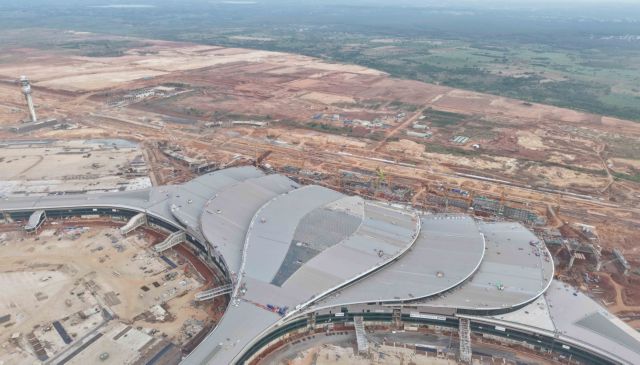
| Long Thành International Airport is seen as a powerful launchpad for Đồng Nai Province’s breakthrough growth. — VNA/VNS Photo |
ĐỒNG NAI — Đồng Nai Province is accelerating a major infrastructure push, positioning transport connectivity as the backbone of its growth strategy for the 2026-30 period.
Under a newly issued action plan, the province aims to mobilise and efficiently deploy resources from the State, businesses and society to build a synchronized, modern infrastructure system, with transport, urban development, digital networks, and technical systems as core pillars.
At the centre of this strategy is a shift towards regional integration.
Authorities have identified transport infrastructure not only as a facilitator of mobility but also as a catalyst for expanding urban-industrial space, enhancing logistics capacity and strengthening competitiveness across the southeastern economic hub.
To realise these ambitions, Đồng Nai plans to mobilise some VNĐ277.38 trillion (US$10.9 billion) between 2026 and 2030.
Public investment is expected to account for VNĐ100.642 trillion ($3.96 billion), including VNĐ25.603 trillion ($1 billion) from central government support.
Private sector participation will play a dominant role, with public-private partnership projects projected to contribute VNĐ136.544 trillion ($5.37 billion), alongside VNĐ13.590 trillion ($534 million) from enterprises and others.
A significant share, of around VNĐ229.853 trillion ($9.04 billion), will be directed to transport infrastructure, underscoring its role as the main growth driver.
Additional allocations include VNĐ13.913 trillion ($547 million) for irrigation and climate adaptation and VNĐ13,792 billion ($542 million) for urban infrastructure.
|
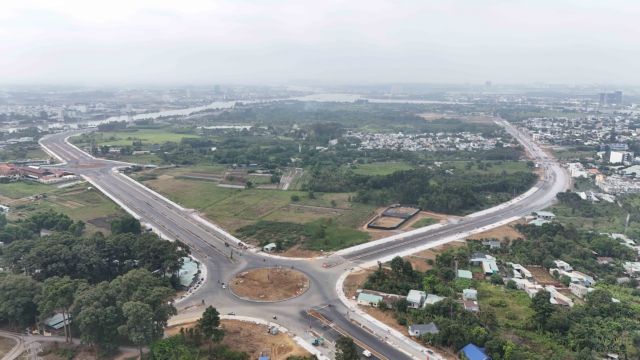
| The central axis road in Đồng Nai Province’s Biên Hòa City is nearing completion, creating a new vital link between the province and HCM City. — VNA/VNS Photo |
Strategic transport corridors take priority
The province is prioritising key projects with strong spillover effects, particularly those that enhance regional connectivity and ease urban congestion.
These include eight major expressways including Biên Hòa – Vũng Tàu, Bến Lức – Long Thành and Dầu Giây – Tân Phú, and other key roads like Ring Roads 3 and 4.
Several projects, notably the Biên Hòa – Vũng Tàu Expressway, Ring Road 3 and sections of the Bến Lức – Long Thành route, are scheduled for completion in 2026, and promise to cut travel time and logistics costs across the region.
Đồng Nai is also investing in interprovincial corridors linking Bình Dương, Lâm Đồng and Tây Ninh, and road networks connecting industrial zones and emerging urban clusters.
A series of major bridge projects will further strengthen connectivity with HCM City and neighbouring provinces.
These include the Phước An, Cát Lái and Phú Mỹ bridges and crossings linking the former Bình Dương Province.
Together, they are expected to ease bottlenecks, improve freight movement and support the expansion of satellite urban areas.
Within the province, key urban transport axes are also being developed, including a riverside road along the Đồng Nai River connecting Vĩnh Cửu, Biên Hòa, Long Thành, and Nhơn Trạch.
Elevated roads and bypass routes, including those along National Highway 51, are intended to ease congestion and improve traffic flow between industrial parks and logistics hubs.
Rail transport is another key component of Đồng Nai’s long-term strategy.
It is coordinating with central authorities to develop major routes, including the North–South high-speed railway, and the Biên Hòa – Vũng Tàu and Dĩ An – Lộc Ninh rail routes.
Plans are also underway for the Thủ Thiêm – Long Thành light railway and an extension of the Bến Thành–Suối Tiên metro line to the provincial administrative centre and Long Thành International Airport.
The airport remains a cornerstone of the region’s development strategy.
Authorities are working to accelerate phase two of the project, including an additional runway and a second passenger terminal.
Once completed, the airport is expected to handle 50 million passengers and 1.5 million tonnes of cargo annually, reinforcing its role as a major international gateway.
Through this infrastructure push, the province aims to remove long-standing bottlenecks in transport, logistics, and investment procedures.
It also seeks to expand its urban-industrial footprint, attract higher-quality investment and achieve rapid but balanced growth in the years ahead.
The strategy reflects a broader shift towards integrated regional development, where connectivity extends beyond roads and bridges to a more seamless economic ecosystem across the country’s south. — VNS
Economy
 Economy
 Economy
 Economy
 Economy
 Economy
 Economy
 Economy
 Economy
 Economy
 Economy
 Economy
 Economy
 Economy
 Economy