 Economy

Top Vietnamese leader meets with Belgian Senate Speaker, House President
1.
|
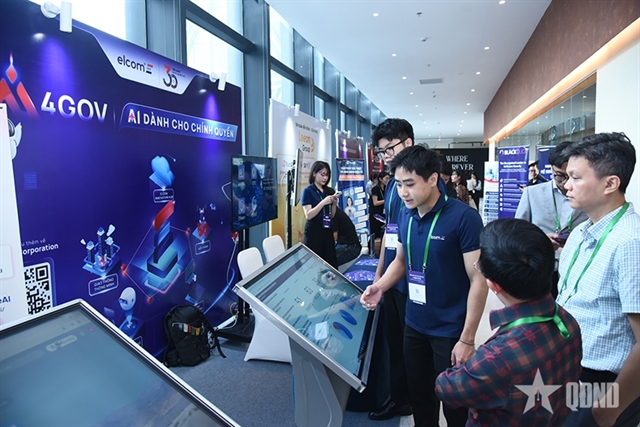
| The exhibition area showcases a range of flagship AI products, highlighting emerging domestic innovation and practical applications. Photo qdnd |
HÀ NỘI — The Vietnam Artificial Intelligence Forum (AI360) 2025 officially opened in Hà Nội on October 9, bringing together policymakers, experts, research institutions and technology businesses to discuss how artificial intelligence can become a new growth engine for Việt Nam’s digital economy.
Organised by the Vietnam Software and IT Services Association (VINASA) under the patronage of the Ministry of Science and Technology, the forum is positioned as a national, annual platform for dialogue and cooperation on AI. This year’s theme, “Building Intelligent Enterprises and Society with AI,” reflects an ambition to accelerate practical adoption while addressing persistent structural constraints.
More than 300 delegates attended the opening session, including leaders of ministries and agencies, industry experts and representatives of the technology business community, marking a significant milestone in Việt Nam’s journey to promote AI development and application.
Fast-growing market, mounting challenges
Việt Nam’s AI market is among the fastest-growing in the region, with its value projected to reach around US$1.52 billion by 2030 and maintain annual growth of about 20 per cent. Adoption indicators also show clear momentum: on average, five enterprises began applying AI every hour in 2024.
According to the Vietnam Artificial Intelligence Annual Report 2025 by the Institute of Information Technology under the Vietnam National University, Hà Nội, based on a survey of nearly 500 enterprises and organisations conducted in July 2025, AI is opening up major opportunities to drive the digital economy. Leading AI-providing sectors include information technology (31 per cent), finance and banking (22 per cent), education (17 per cent), and e-commerce and healthcare (15 per cent).
Demand for AI applications is particularly strong in five key areas: finance (26 per cent), education (23 per cent), industrial manufacturing (21 per cent), healthcare (16 per cent) and transport (15 per cent).
Speaking at the forum, Nguyễn Khắc Lịch, Director of the Department of IT Industry under the Ministry of Science and Technology, said Việt Nam has been steadily strengthening its position on the global AI map in recent years.
According to Oxford Insights’ Global AI Readiness Index 2024, Việt Nam ranks 59th out of 193 countries, placing it among the top five in ASEAN and above the global average for three consecutive years. “This is an encouraging achievement, reflecting the Government’s strategic vision as well as the persistent efforts of businesses and the expert community,” he said.
Public trust in AI is also rising rapidly. The World AI Index 2025 ranks Việt Nam sixth out of 40 countries, third globally in terms of trust in AI, and fifth for AI acceptance. “These figures are not only about technology; they demonstrate the openness, readiness and confidence of Vietnamese society in a new era,” Lịch noted.
Investment in AI is accelerating, with funding for domestic AI enterprises rising eightfold from $10 million in 2023 to $80 million in 2024. AI applications are now present across finance, healthcare, e-commerce, manufacturing and smart cities, helping address real-world national challenges.
“With a young population, a promising technology workforce and strong strategic direction from the State, Việt Nam’s AI ecosystem is ready for a new leap forward,” Lịch said.
However, experts at the forum also highlighted major bottlenecks. Around 45 per cent of AI solution providers cited a shortage of high-quality human resources, while 23 per cent face difficulties related to data and computing infrastructure. Meanwhile, 30 per cent expressed concerns about the lack of a clear legal framework.
Data constraints remain a core challenge: 50 per cent of AI providers said they have limited or no access to standardised datasets, while 51 per cent of training institutions reported insufficient-quality data for model training. The report also pointed to a fundamental imbalance in the AI value chain, with a wide gap between investment in AI development and investment in AI adoption.
While technology providers are scaling up projects with investments typically ranging from VNĐ1–3 billion, spending on AI among users in five priority sectors—education, healthcare, finance, transport and industry—remains modest.
From policy to practical solutions
One of the most discussed topics at AI360 was the application of AI in the two-tier local government model. Administrative restructuring and workforce streamlining are placing significant pressure on grassroots officials, with staff shortages coinciding with sharply rising workloads. Currently, as many as 1,065 tasks have been decentralised to the commune level.
According to enterprise case studies shared at the forum, AI assistants available 24/7 could help reduce document search time by up to 60 per cent while improving file quality. Public service chatbots capable of automatically classifying and routing applications could handle around 70 per cent of common citizen requests. In terms of operations, combining AI with robotic process automation (RPA) could cut processing time by 40–60 per cent, while enabling workload forecasting and staff allocation.
Experts agreed that two tasks dominate the workload of civil servants: document processing and reporting. AI-powered assistants and multi-channel chatbots can support document handling across applications, websites and kiosks, while AI-driven management and reporting systems - with flexible, user-friendly customisation - can replace legacy software.
By automating processes and enhancing forecasting capabilities, AI can help two-tier governments improve efficiency, strengthen staff capacity and ultimately increase citizen satisfaction.
Towards business value
Another highlight was the thematic session on building product development capacity in the era of generative AI. At the session, VINASA unveiled a draft AI Capability Maturity Framework, designed as a comprehensive guide for technology enterprises. The framework covers key factors such as value measurement and return on investment, data readiness, core technology capabilities, innovation speed and risk governance, helping businesses assess and allocate resources more effectively.
VINASA Chairman Nguyễn Văn Khoa said that while 2023 was “the year of proofs of concept,” 2025 has become “the year of real business value.”
“The wave of generative AI, especially AI agents with autonomous operational capabilities, is fundamentally changing how businesses are run and managed,” Khoa said. “VINASA is committed to accompanying enterprises, taking the Government’s strategic direction as our compass.”
He added that addressing AI bottlenecks requires three urgent actions: shifting from experimentation to measurable business value; standardising capabilities through the AI Capability Maturity Framework, known as STAIR (Strategic Transformation & AI Readiness); and building a connected ecosystem that brings AI from laboratories to real-world applications through stronger links among Government, research institutions and businesses.
Alongside in-depth discussions, the forum featured AI & CEO Networking, attracting more than 100 business leaders, investors and research institutes to promote B2B and B2G cooperation. An exhibition showcased ten booths displaying AI products in commerce, finance, healthcare, education and logistics, highlighting the growing creativity and technological capacity of Việt Nam’s domestic AI ecosystem. VNS
Economy
 Economy
 Economy
 Economy
 Economy
 Economy
 Economy
 Economy
 Economy
 Economy
 Economy
 Economy
 Economy
 Economy
 Economy