 Politics & Law

LANDMARK Launches ‘Destination CENTRAL’: A District-Wide Invitation to Explore the Dynamism, Luxury, and Soul of Central
1.
 |
| THE FUTURE: Children who survived the 2024 flash flood that buried Nủ Village in Lào Cai Province return to school with smiles on their faces. VNA/VNS Photo Hoàng Hiếu |
Professor Trần Thọ Đạt, National Economics University
As Việt Nam prepares to celebrate the 81st anniversary of National Day, its entry into the upper-middle-income group offers a legitimate reason for pride. But it is also a warning against complacency. The growth model that carried the country this far will not, by itself, deliver its aspiration of becoming a high-income country by 2045.
 |
| Professor Trần Thọ Đạt, National Economics University. Photo courtesy of Trần Thọ Đạt |
On September 2, Việt Nam will mark 81 years since the Declaration of Independence in 1945. That anniversary invites more than reflection on the distance travelled. It also raises a forward-looking question: what kind of economy must Việt Nam become by the centenary of the nation in 2045?
The record is extraordinary. From a war-damaged, centrally planned and overwhelmingly agrarian economy, Việt Nam has become a major manufacturing and trading nation. The policy of Đổi mới (Renewal) released productive energy, international integration widened markets, and investment in people and infrastructure improved living standards on a scale few could have imagined in 1945.
The World Bank's decision in July to classify Việt Nam as an upper-middle-income economy is the latest marker of that journey. The classification, based on a 2025 Atlas-method GNI per capita of about US$4,970, confirms real progress. Yet an income threshold is a statistical milestone, not a certificate of development. It says where a country has arrived; it does not guarantee where it will go next.
At 81, the most meaningful way to honour an exceptional past is therefore not self-congratulation, but clarity about the next frontier. Việt Nam must now make a more difficult transition: from an economy that has been highly effective at mobilising resources to one that uses them with much greater productivity and creates more value of its own.
The middle-income trap has no warning line that an economy suddenly crosses. It forms gradually when investment keeps rising but returns decline; when wages increase faster than productivity; and when firms lose their cost advantage before acquiring strengths in technology, management, design and brands. Income may continue to rise, but the development curve becomes flatter.
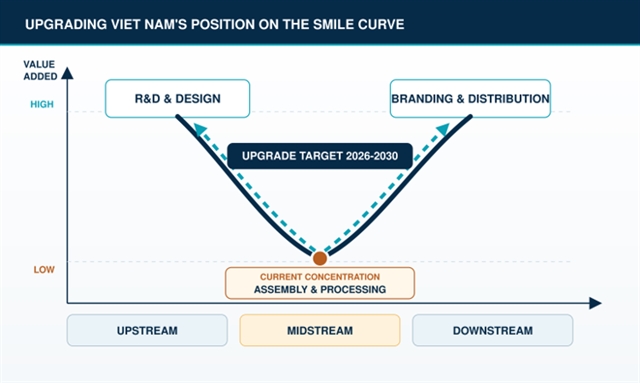 |
| TASK AT HAND: Figure 1. The strategic task is to help more Vietnamese firms move from low-value assembly and processing towards R&D and design upstream, and branding and distribution downstream. |
This is why the problem should not be reduced to a single income number. It lies in the structure of growth. Việt Nam can export hundreds of billions of US dollars and still remain vulnerable if the most valuable functions – core technology, product architecture, design, intellectual property, branding and distribution – are located elsewhere. Gross export value may be impressive while the value retained by Vietnamese firms and workers remains comparatively thin.
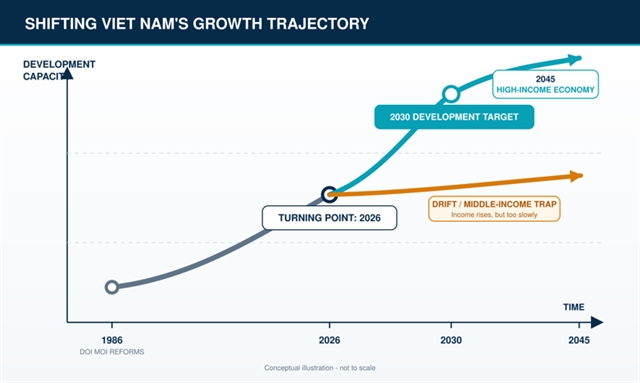 |
| VALUE CREATION: Figure 2. Viet Nam must shift from capital- and cost-led growth towards a trajectory driven by productivity, innovation and domestic value creation; otherwise income may continue to rise, but too slowly to avoid the middle-income trap (Conceptual illustration, not to scale). |
The same distinction applies to investment. For many years, expanding capital, credit, land and labour was an appropriate response to scarcity. But that approach is reaching its limits. Delayed projects, fragmented infrastructure, speculative uses of land and credit, and lengthy procedures all lower the productivity of capital. More finance cannot indefinitely compensate for weak allocation, and credit cannot substitute for reform.
Nor is this an argument for abandoning manufacturing or foreign investment. Việt Nam's industrial base is a national asset. The task is to deepen it: to make manufacturing more Vietnamese in capability and value capture; to connect foreign-invested companies with competitive local suppliers; and to enable domestic firms to move from subcontracting towards engineering, product development and international market access.
A new trajectory
The national targets for 2030 are deliberately ambitious: average annual GDP growth of at least 10 per cent and GDP per capita of around $8,500. These goals should be understood as reform targets, not automatic forecasts. One or two years of very high growth can be supported by a cyclical rebound, faster public investment disbursement or rapid credit expansion. A decade of high growth requires a sustained increase in the economy's productive capacity.
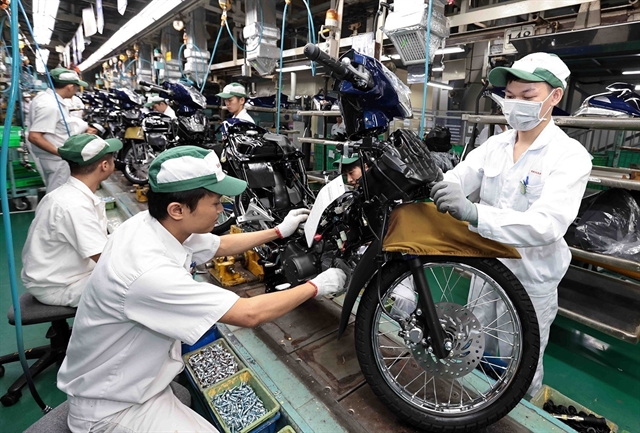 |
| ON THE FLOOR: A motorcycle assembly line at the Honda Phúc Yên factory in Phú Thọ Province. Việt Nam's industrial base is a national asset. VNA/VNS Photo Trần Việt |
If Việt Nam attempts to reach the target mainly by pushing more capital through the existing structure, the result could be higher debt, higher asset prices and declining investment efficiency. The country needs public investment, but it must unlock rather than crowd out productive private investment. It needs credit, but capital must reach firms with viable projects rather than remain concentrated in property and collateral. It needs foreign investment, but the quality of local links matters as much as registered capital.
The strategic direction is increasingly clear. Recent policy frameworks on science and technology, private sector development and the renewal of the development model place productivity, innovation, digital transformation and more efficient resource allocation at the centre of the 2026-2030 agenda. The important shift is from asking how much capital the economy can mobilise to asking how much additional value each unit of capital can create.
Innovation, in this context, should not be treated as a fashionable label for a small number of high-tech projects. It means turning knowledge into higher productivity and market value across the economy.
A textile company using digital design, clean energy, traceable materials and its own brand is part of the new model. So is a farm using data to raise yields, reduce water use and meet demanding export standards.
The objective is not to make every sector look high-tech. It is to make every sector more productive, greener and better able to retain value in Việt Nam.
Advancing together
The first requirement is to turn science, technology and data into productive capability. Resolution 57 [issued in December 2024 by the Communist Party of Việt Nam on breakthroughs in the development of science and technology] sets a target for research and development expenditure to reach 2 per cent of GDP by 2030, with more than 60 per cent coming from non-state sources.
 |
| TRANSPORT ICON: The Cát Linh-Hà Đông urban railway line in Hà Nội, the first urban railway line in the country. VNA/VNS Photo Tuấn Anh |
The scale of spending matters, but the outcome matters more. The real measures of success are technologies commercialised, firms made more productive, patents used in production and Vietnamese products able to command better prices.
The State should concentrate on public goods that individual firms cannot provide alone: fundamental research, shared laboratories, digital and data infrastructure, standards and selected strategic technologies.
Enterprises, meanwhile, must become the main actors in applied research and commercialisation. Tax incentives should reward genuine R&D; public procurement should create credible first markets for domestic technologies; and regulatory sandboxes should permit controlled experimentation.
The second requirement is to turn foreign investment from an export platform into a source of domestic capability. The success of investment policy should increasingly be judged by domestic purchasing, the number of Vietnamese suppliers upgraded, workers and managers trained, and research functions located in the country.
This is not about administratively forcing technology transfer. It is about creating the skills, incentives and supplier capacity that make deeper local integration commercially attractive.
The third requirement is to make domestic private enterprise a leading force in innovation. No large economy reaches high-income status without national firms that can scale, invest for the long term and compete abroad. The policy environment must reward investment in technology, people and brands more than privileged access to scarce land, credit or protected markets.
For entrepreneurs, predictability is itself a productive resource: a business cannot commit to long-horizon innovation when regulatory risk is greater than market risk.
All three capabilities depend on people. In the first half of 2026, only 29.7 per cent of the labour force had formal qualifications or certificates. The figure does not capture every skill in the economy, but it exposes the size of the upgrading task.
Việt Nam needs stronger vocational education, closer university-industry cooperation, high-level engineers and technology managers, and a culture of lifelong learning for workers affected by automation.
Việt Nam cannot build a semiconductor industry through an enrollment campaign, or an AI economy by purchasing software. Technological capability is accumulated through years of research, production, problem solving and management.
The next chapter
Việt Nam does not lack strategies or ambition. The persistent weakness is the distance between policy intention and implementation. A new growth model will remain rhetorical unless it changes the everyday incentives facing investors, officials, researchers and enterprises.
Economic rules must be clear, stable and applied consistently. The system should move from excessive prior approval towards effective post-inspection and risk-based supervision. Land, credit, data and talent must flow towards productive uses rather than towards those with the strongest administrative connections. Competition should be fair among state-owned, foreign-invested and domestic private enterprises.
Implementation also requires a state capable of converting decisions into results. Every major programme should identify the responsible authority, resources, deadlines and measurable outcomes.
Decentralisation must come with data, professional capacity and accountability. The continuing restructuring of government can shorten decision chains and bring administration closer to citizens and businesses, but only if authority and responsibility move together.
This is especially important for the green transition. Carbon standards, traceability and low-emission requirements are becoming conditions of market access. If they are treated only as costs, Vietnamese firms will remain followers. If they are used to accelerate investment in clean technology, measurement systems, green finance and efficient supply chains, they can become a new competitive advantage.
There are only 19 years between the 81st anniversary of National Day and the centenary of the nation. That is a short period in which to complete a high-income transformation. The first great achievement of modern Việt Nam was to overcome scarcity and isolation. The next is to overcome low productivity, shallow domestic linkages and dependence on value created elsewhere.
A high-income country is not defined only by a higher dollar figure. It is an economy in which productive firms can grow, knowledge can become commercial value, workers are rewarded for rising productivity, and institutions can sustain public trust.
Entering the upper-middle-income group deserves pride. Turning that milestone into a new trajectory will require institutional discipline, entrepreneurial courage and a national commitment to knowledge.
That is a development task worthy of Việt Nam's 81st National Day, and the foundation on which the aspiration for 2045 must be built. VNS
Politics & Law
 Politics & Law
 Politics & Law
 Politics & Law
 Politics & Law
 Politics & Law
.jpg) Politics & Law
Politics & Law
 Politics & Law
 Politics & Law
 Politics & Law
 Politics & Law
 Politics & Law
 Politics & Law
 Politics & Law
 Politics & Law