 Politics & Law

ZOOD Real Estate launches Élevée, a $667 million project in north Riyadh
1.
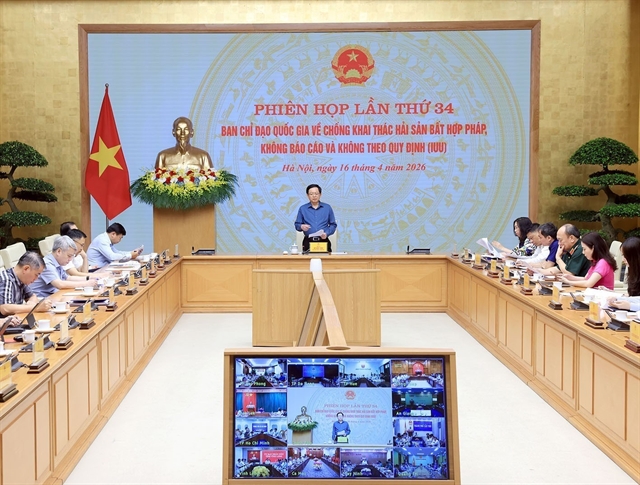 |
| Deputy Prime Minister Hồ Quốc Dũng chairs the meeting. — VNA/VNS Photos Tuấn Anh |
HÀ NỘI — Deputy Prime Minister Hồ Quốc Dũng has urged stronger accountability, tighter inspection and enforcement, and a decisive push to lift the European Commission (EC)'s yellow card as he chaired the 34th meeting of the National Steering Committee on Combating Illegal, Unreported and Unregulated (IUU) Fishing yesterday.
At the meeting, the Ministry of Agriculture and Environment (MAE) reported that Việt Nam has essentially completed its legal framework and established systems for fisheries management, vessel monitoring and catch traceability in line with international practices after more than eight years of anti-IUU efforts.
Core databases, including the national fisheries database (VNfishbase), vessel monitoring, electronic catch traceability and an administrative violations database, are now connected from central to local levels and interoperable with the national population system (VNeID).
As of April 14, more than 80,350 fishing vessels of six metres and above were registered in VNfishbase, with over 76,700 holding valid licences. Authorities have announced 86 operational fishing ports, designating 72 to receive offshore vessels and 51 to certify the origin of wild-caught seafood.
Electronic data capture and logbooks basically meet end-to-end traceability requirements and can interface with EU and Food and Agriculture Organization systems.
From 2024 to April 15, 2026, foreign authorities detained 101 Vietnamese vessels, a marked decline from previous years.
An EC inspection in March acknowledged progress in handling IUU fishing violations, particularly those in foreign waters, but highlighted unresolved shortcomings hampering removal of the yellow card. These include incomplete vessel marking and registration display, insufficient control of port entries/exits and landed catches, uneven traceability of imported wild-caught seafood transported by container, slow case handling and incomplete data updates.
Shortcomings cited by the ministry included limited local enforcement capacity, uneven leadership and resourcing, non‑interoperable databases, gaps in monitoring technology, weak port infrastructure and constrained management resources. Other issues include the small size of many vessels, limited technology uptake, low compliance among a segment of fishermen and a lack of alternative livelihoods.
Concluding the meeting, the Deputy PM said shortcomings stem from execution rather than a lack of guidance. He ordered ministries, sectors and localities to review implementation of prior directives, with the Government Office tasked with reporting on compliance.
Dũng assigned the MAE, the Steering Committee’s standing body, to propose a standing inter-agency task force to work regularly in localities to inspect, expedite and resolve bottlenecks, instead of relying on periodic meetings.
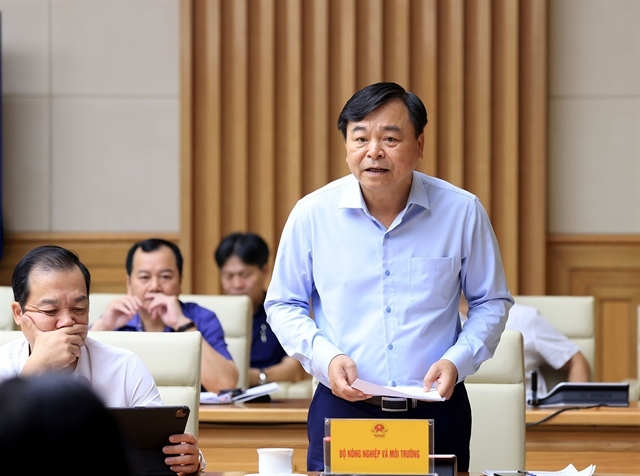 |
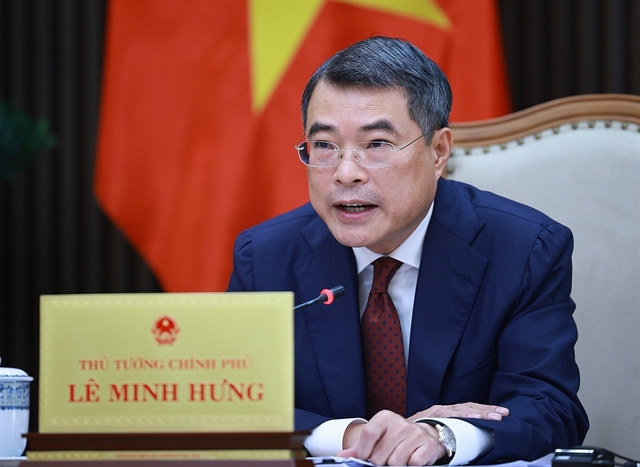
| A representative of the Ministry of Agriculture and Environment speaks at the meeting. |
He also urged swift submission of a decree to replace Decree 38/2024/NĐ-CP on administrative penalties in fisheries, raising fines to strengthen deterrence in line with EC recommendations. A comprehensive review of legal and management processes, from fleet control and traceability to raw material imports, will also be undertaken to promptly close loopholes.
Local inspection and supervision must be tightened and tied to the accountability of local leaders, with commendations for effective jurisdictions and corrective measures where management is lax, the Deputy PM added.
The Ministry of National Defence was asked to step up at-sea inspection and control to prevent new violations in foreign waters.
Meanwhile, the Border Guard will manage departures while strengthening outreach to fishermen, the Ministry of Public Security will investigate and dismantle broker networks organising illegal fishing abroad, and the Ministry of Finance will review seafood trade procedures, clarify EC‑noted violations and propose funding for anti‑IUU efforts.
For coastal localities, Dũng called for action on outstanding issues, especially installing vessel monitoring devices, controlling port entries and exits, ensuring traceability and enforcing penalties. He also suggested setting up inter-agency teams at fishing ports, including border guards, fisheries surveillance and provincial fisheries authorities, to strengthen oversight. — VNS
Politics & Law
 Politics & Law
 Politics & Law
 Politics & Law
 Politics & Law
 Politics & Law
 Politics & Law
 Politics & Law
 Politics & Law
 Politics & Law
 Politics & Law
 Politics & Law
 Politics & Law
 Politics & Law
 Politics & Law