 Economy



Care economy can help drive empowerment of women: deputy minister
1.

|
| A shopper purchasing a product on the Shopee application. — VNA/VNS Photo |
By Ly Ly Cao
HÀ NỘI — Việt Nam is streamlining digital infrastructure and customs procedures to support cross-border e-commerce as online exports expand, as authorities seek better data connectivity.
These issues were discussed at the Vietnam Cross-Border E-commerce Forum (VOIEF) 2026, held in Hà Nội on October 8 under the theme 'Impacts of Digital Transformation in Customs'.
According to the Ministry of Industry and Trade (MoIT), Việt Nam's e-commerce market reached around US$31 billion in 2025, putting the country among the world's top 10 e-commerce markets and third in ASEAN. Online exports grew 78 per cent, while the total value of imports and exports conducted through e-commerce channels was about $4.45 billion, accounting for only a small portion of the country's overall trade.
Trần Thủy Tiên, a presentation from the Vietnam E-commerce and Digital Economy Agency (iDEA), under the MoIT, said cross-border e-commerce could provide a 'second door' for Vietnamese businesses to reach international consumers more directly, reducing some of the intermediary costs and time associated with traditional export channels.
Tiên estimated Việt Nam's online exports at about $2 billion in 2025, while the global cross-border e-commerce market was projected at $791.5 billion over the same period.
However, businesses continue to face challenges related to foreign-market regulations, product traceability, international payments, logistics and customs procedures.
Trịnh Thị Thu Hiền, deputy director of the Import-Export Department under the MoIT, said the potential for online exports should be viewed through three key aspects: products, markets, and support channels.
Việt Nam already exports products across a broad range of sectors, from fresh and processed agricultural products to consumer goods, textiles, footwear, machinery, computers and electronic products. However, much of this trade still takes place through conventional channels, while the value of goods exported through e-commerce platforms remains limited.
"The range of products using e-commerce platforms is still limited to certain consumer goods," Hiền said.
"For other products, coverage is still very limited."
She said this represented a constraint and an area for further expansion, particularly in determining how more products beyond consumer-orientated goods could be exported through digital platforms.
Market access presents another challenge.
Việt Nam already exports internationally, but Hiền said the destinations reached through e-commerce remain limited, with online exporters tending to focus on a number of nearby markets. For more distant markets, transportation and import-country procedures can make online exports more complicated.
She also stressed the importance of information for businesses seeking to enter foreign markets.
"Information needs to be accurate and sufficient," Hiền said, adding that businesses should not rely solely on information supplied by domestic authorities. They also need to proactively study the regulations of destination markets, including specific import and export requirements applicable to goods sold through e-commerce platforms.

|
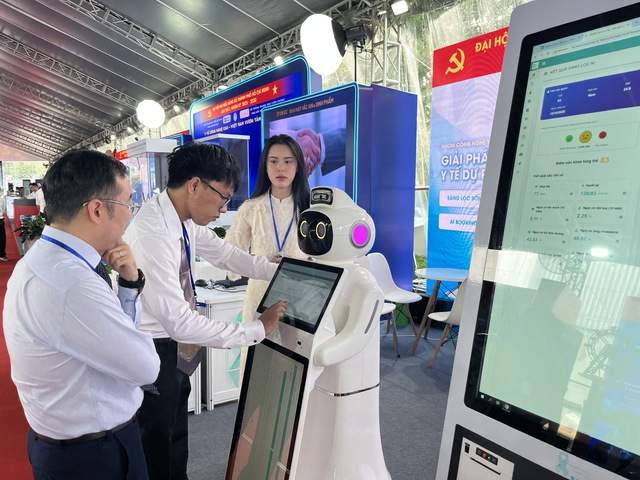
| Companies bring solutions to the event on Thursday morning. — VNS Photo Ly Ly Cao |
Digital customs infrastructure
The revised Customs Law is expected to provide a more specific legal framework for goods traded through e-commerce platforms.
According to Nguyễn Thu Huyền, deputy head of the Customs Management Supervision Division's NV4 team, the rapid development of e-commerce and the emergence of different business models have created a need for dedicated customs procedures.
Previously, goods traded through e-commerce platforms could be subject to different customs procedures depending on the mode of transport, without a separate procedure specifically designed for e-commerce transactions.
Under Article 16a on customs inspection and supervision of goods exported and imported through e-commerce platforms, such goods must undergo customs procedures and be subject to customs inspection and supervision.
Vietnamese organisations and individuals buying or selling goods with foreign countries through e-commerce platforms will also be required to carry out electronic identification and authentication. E-commerce platform operators will be responsible for connecting with the customs authority's e-commerce data processing system when carrying out electronic identification and authentication.
Platform operators, bonded warehouse businesses, carriers or their agents and other organisations and individuals related to goods traded through e-commerce platforms will also have responsibilities to provide relevant information about the goods to customs authorities.
Huyền said the customs authority was developing a system for electronic identity authentication and information exchange among State agencies.
"To reduce compliance costs, the customs authority is currently developing software for electronic identity authentication between State agencies, such as the Ministry of Finance and the Ministry of Public Security, with e-commerce platforms also connecting to the system so they can benefit, rather than having to carry out this task themselves," Huyền said.
The digital customs system is designed to manage imports and exports from the beginning to the end of the process, digitise customs procedures and enable information to be shared from pre-arrival data through completion of customs clearance. It is also being developed on an open architecture that can connect and share information with other government systems and international systems.
The customs authority said advance information on goods would allow customs to conduct risk assessment before shipments arrive, potentially reducing the need for physical inspections and facilitating clearance.
The system is also intended to increase transparency in customs procedures and reduce logistics costs, including warehousing and customs-processing expenses. — BIZHUB/VNS
Economy
 Economy
 Economy
 Economy
 Economy
 Economy
 Economy
 Economy
 Economy
 Economy
 Economy
 Economy
 Economy
 Economy