.jpg) Economy
Economy

SHB unveils sustainable finance framework to expand green and social lending
1.
|
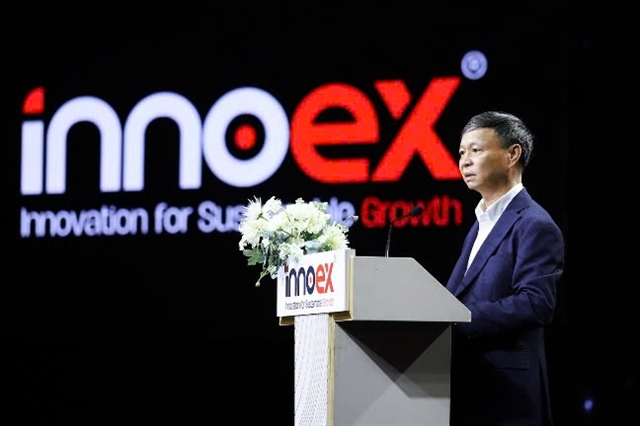
| Deputy Minister of Science and Technology Hoàng Minh delivers a speech at the InnoEx 2026 in HCM City. — Photo courtesy of the organiser |
HÀ NỘI — The Government plans to strengthen its role as an early customer for domestically developed technology, using public resources and procurement to help businesses test products, improve production processes and bring innovations to market.
Deputy Minister of Science and Technology Hoàng Minh said the approach would form part of efforts to turn science, technology and innovation into measurable gains in productivity, new products and new markets, rather than stopping at research outcomes.
Speaking at the International Innovation Forum and Exhibition 2026 (InnoEx 2026), Minh said the State would act as an enabler, share risks with businesses and help create initial orders so Vietnamese technologies could be validated, commercialised and subsequently expanded into wider markets.
The approach comes as science, technology, innovation and digital transformation take on a greater role in Việt Nam's long-term economic competitiveness.
Resolution No 57-NQ/TW identifies these areas as a key breakthrough and a major driver of rapid and sustainable development, while Resolution No 68-NQ/TW recognises the private sector as one of the important engines of the economy.
Technology and innovation are expected to become capabilities through which businesses can generate new sources of growth.
"The ultimate value of science, technology and innovation must be translated into higher productivity, new products, new markets and new competitive advantages for Vietnamese enterprises," Minh said.
He highlighted the importance of starting innovation from market demand while strengthening enterprises' capacity to absorb and master technology.
Innovation should address what markets and customers need and what value businesses can create, while improving their ability to incorporate technology into production, management and product development.
Another focus is strengthening links among the state, research institutes, universities and businesses.
According to Minh, the gap between laboratories and markets can only be narrowed when enterprises participate from the stage of defining requirements through testing and technology refinement, while universities and research institutes work more closely on problems arising from business operations.
Vietnamese enterprises are also being encouraged to expand international cooperation and participate more deeply in global value chains.
Such cooperation should go beyond technology acquisition to include joint research and product development, investment mobilisation and participation in international supply chains.
Minh said that if enterprises were to become the central actors in innovation, the state's responsibility was to create an environment in which they could more easily conduct research, experiment with technologies, deploy them commercially and bring resulting products to market.
The Ministry of Science and Technology is therefore working to improve institutions and implementation mechanisms across the entire innovation value chain.
Instead of ending state support when a research project is accepted, the approach is intended to continue until technology is mastered, products are commercialised and they gain market acceptance.
A notable element is the emerging mechanism under which the state acts as the "first customer" for Vietnamese technology.
State resources would serve as seed funding and help share risks during early development stages, alongside mechanisms for commissioning and public procurement of domestically developed products and technologies.
"An initial order does not only generate revenue but also gives businesses an opportunity to validate their products, improve production processes and expand their markets," Minh said.
Shared technology infrastructure will also be developed, covering laboratories, design facilities, testing and inspection systems and pilot production facilities.
The infrastructure is intended to allow businesses, particularly small and medium-sized enterprises, to test and validate products before committing substantial investment.
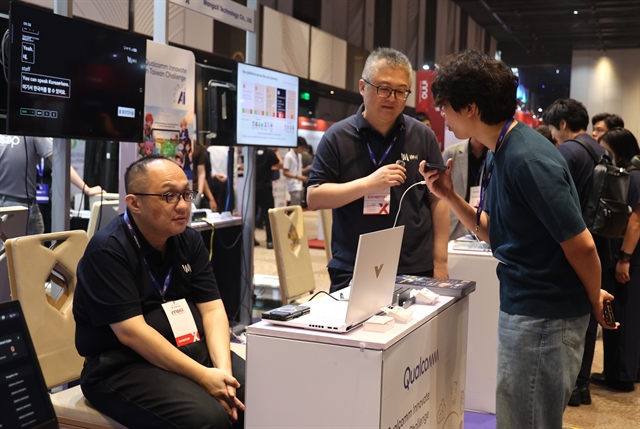
InnoEx 2026, held in HCM City on August 19-20, brought together more than 4,000 chief executives, founders and senior business leaders, more than 70 international investment funds and hundreds of experts.
The two-day event provided a platform connecting businesses, start-ups, investors and solution providers while facilitating cooperation, investment and access to technology, innovation and digital transformation solutions. — BIZHUB/VNS
Economy
 Economy
 Economy
 Economy
 Economy
 Economy
 Economy
 Economy
 Economy
.jpg) Economy
Economy
 Economy
 Economy
 Economy
 Economy
 Economy