 Economy


VN-Index ends lower despite liquidity hit over $1 billion
1.
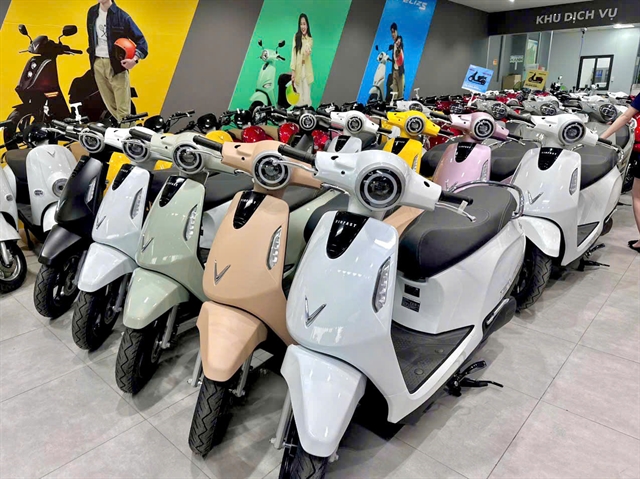 |
| A VinFast electric motorbike showroom. — Photo vinfastecoxe.vn |
HÀ NỘI — Rising fuel prices and Hà Nội’s roadmap to restrict gasoline-powered motorbikes from mid-2026 are accelerating a major shift in the two-wheeler market, turning electric motorbikes from a trend into an inevitable choice.
Data from the Vietnam Association of Motorcycle Manufacturers (VAMM) shows that traditional manufacturers experienced a noticeable slowdown last year, with total market sales reaching 2.6 million units, down 1.5 per cent year-on-year.
This decline reflects not only market fluctuations but also changing consumer behaviour under pressure from rising fuel costs.
As RON 95 gasoline prices surged above VNĐ30,000 (US$1.15) per litre by late last month, the operating cost of gasoline-powered vehicles has become a significant financial burden for most workers.
In addition, a decisive push has come from Hà Nội’s low-emission zone (LEZ) roadmap.
The Hà Nội People’s Council approved a resolution introducing LEZs on November 27 last year, effective from July 1 this year.
Gasoline-powered motorbikes will be restricted during certain hours within Ring Road 1. The policy will expand to Ring Road 2 by 2028 and Ring Road 3 by 2030.
This roadmap is shifting consumer perception from wanting to switch to being compelled to switch to electric vehicles.
While traditional manufacturers are still adjusting their strategies, VinFast has taken an early lead in positioning the market.
Last year marked the beginning of a new growth phase for electric motorbikes, with VinFast reporting sales of 406,453 units, an increase of nearly 500 per cent compared to the previous year.
This reflects both the company’s rapid growth and a strong shift among Vietnamese consumers towards green mobility.
According to its development roadmap announced in January, VinFast has developed three electric motorbike segments: mass-market, premium and sports.
The mass-market segment remains the backbone, with more than 10 models catering to both personal and commercial use. Meanwhile, the launch of premium and sport models marks a significant expansion into segments traditionally dominated by gasoline-powered bikes.
These new models feature major investments in design, performance, and user experience, narrowing the gap between electric and gasoline motorbikes.
With a product portfolio spanning all segments, VinFast is increasingly covering the full spectrum of consumer demand, leaving limited room for competitors.
The company’s rapid growth is driven not only by product diversity but also by infrastructure. Its strategy of developing charging stations and flexible battery-swapping networks has addressed one of the biggest barriers for urban residents, particularly those living in apartment complexes.
Automotive expert Mạnh Thắng noted that the combination of fixed batteries and flexible battery leasing offers an effective solution for urban users.
As electric motorbikes continue to improve in both functionality and user experience, traditional manufacturers will be forced to accelerate electrification or risk falling behind in Việt Nam’s emerging green mobility era, he said.
Liu Jia, general director of YADEA Vietnam, described Việt Nam as one of the most promising two-wheeler markets globally.
With the planned restrictions on gasoline motorbikes, he said the electric segment could double annually over the next three to five years.
YADEA aims to capture a 20 per cent market share by mastering three core technologies: motors, batteries and controllers. Its strategy this year includes nationwide district-level coverage and integrating roadside assistance services via the Zalo platform using GPS.
This intensifying competition is benefiting consumers, as manufacturers diversify their offerings. Electric motorbikes are no longer limited to students.
Premium models, positioned as alternatives to high-end gasoline scooters such as SH and Vespa, are gradually emerging, targeting practical consumers who prioritise operating costs over brand display.
According to industry experts, fierce competition is accelerating a market shakeout, in which green, technology-integrated and cost-efficient vehicles will define the next competitive landscape.
This year is shaping up to be a turning point, paving the way for electric motorbikes to become the backbone of urban transportation in Việt Nam. — VNS
Economy
 Economy
 Economy
 Economy
 Economy
 Economy
 Economy
.jpeg) Economy
Economy
 Economy
.jpeg) Economy
Economy
 Economy
 Economy
 Economy
 Economy
 Economy