HÀ NỘI – A hybrid robot developed by students at Hà Nội University of Science and Technology (HUST) can roll on wheels, walk on two legs and even jump, combining speed and efficiency with the ability to tackle uneven terrain.
The robot recently won first prize in HUST’s annual student research competition, highlighting the practical potential of student-led innovation in robotics.
Guided by Dr Nguyễn Tiến Dũng and MA Lê Bảo Việt, the research team comprises four students from HUST’s School of Mechanical Engineering.
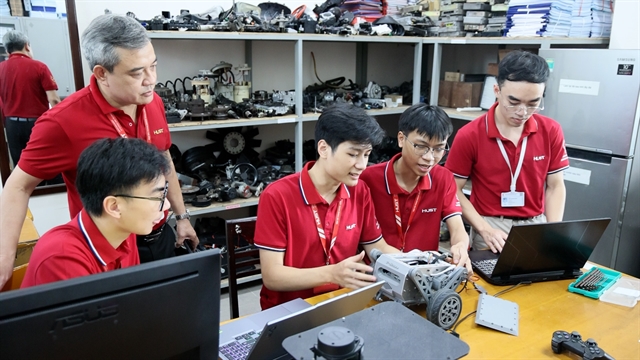 |
| Dr Nguyễn Tiến Dũng (standing) and his students in the team. VNS Photo Lê Hương |
The two-legged wheeled robot, known as a wheeled bipedal robot (WBR), is designed to combine the advantages of two forms of locomotion.
Its wheels allow it to move quickly and efficiently on relatively smooth surfaces, while its legs give it greater adaptability when navigating uneven or challenging terrain.
The hybrid configuration also enables the robot to maintain its balance on two legs and perform controlled jumps.
At the heart of the system is a compact hierarchical control architecture designed to operate on a low-cost embedded microcontroller without relying on complex online computing.
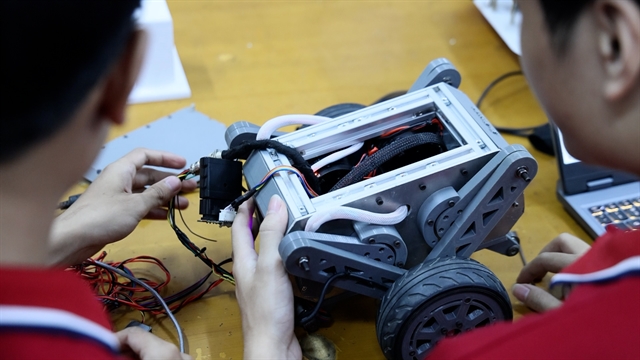 |
| The robot has a complex structure. VNS Photo Hải Anh |
The team combines a wheeled inverted-pendulum model with a Linear Quadratic Regulator (LQR) controller to maintain balance. A virtual-model control system is also used to adjust the robot’s overall posture.
This approach allows the robot to respond to changes in terrain while maintaining stability.
One of the project's key achievements is a single continuous control process that operates throughout the robot’s four jumping phases: compression, extension, free flight and landing.
 |
| The robot has undergone many improvements before reaching its final form. VNS Photo Lê Hương |
Rather than switching between separate control systems during the jump, the robot uses an adaptive signal mechanism.
When the robot leaves the ground, weight-compensation and LQR state feedback are automatically adjusted according to a binary signal representing whether the robot is in contact with the ground.
This helps prevent disruptions in the control model and enables the robot to land and regain balance smoothly.
Simulation and real-world experiments showed that the robot could maintain a longitudinal tilt angle of less than 5 degrees.
 |
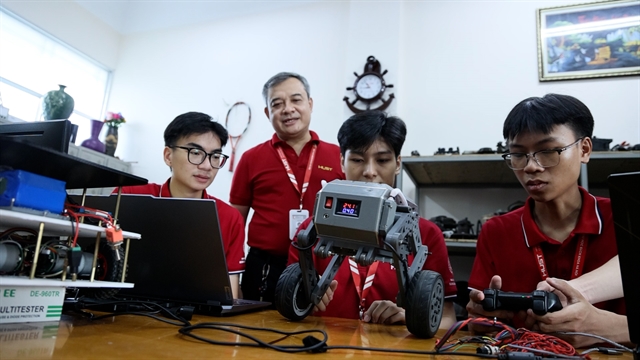
| It can be remotely controlled. VNS Photo Lê Hương |
Its velocity error remained at around 0.048 metres per second while operating on sloping, undulating and asymmetric surfaces.
The results demonstrate the potential of the control architecture to overcome computational limitations that often constrain autonomous robotic systems.
The team says the hybrid design could have practical applications in environments where robots need both speed and mobility.
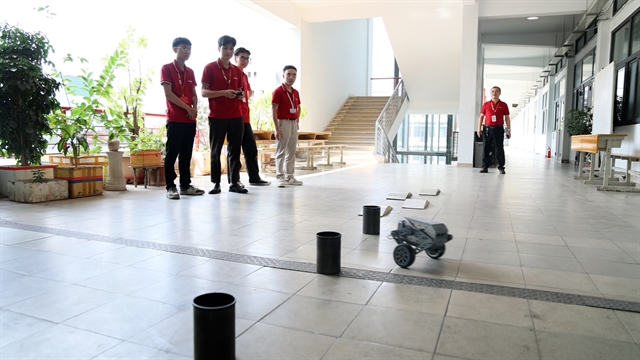 |
| The research group tests the robot’s movements. VNS Photo Hải Anh |
Potential uses include security, logistics and disaster response, particularly in areas with uneven terrain or difficult access for conventional wheeled robots.
The researchers believe the combination of a relatively simple control architecture and low-cost embedded hardware could also open up opportunities for developing and commercialising affordable mobile robots for challenging environments. VNS
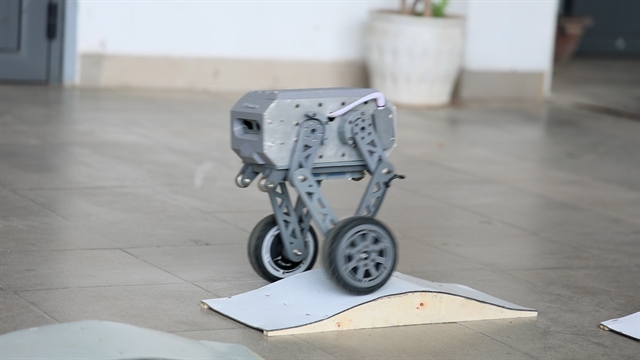 |
| The robot maintains its balance on uneven terrain. VNS Photo Lê Hương |